
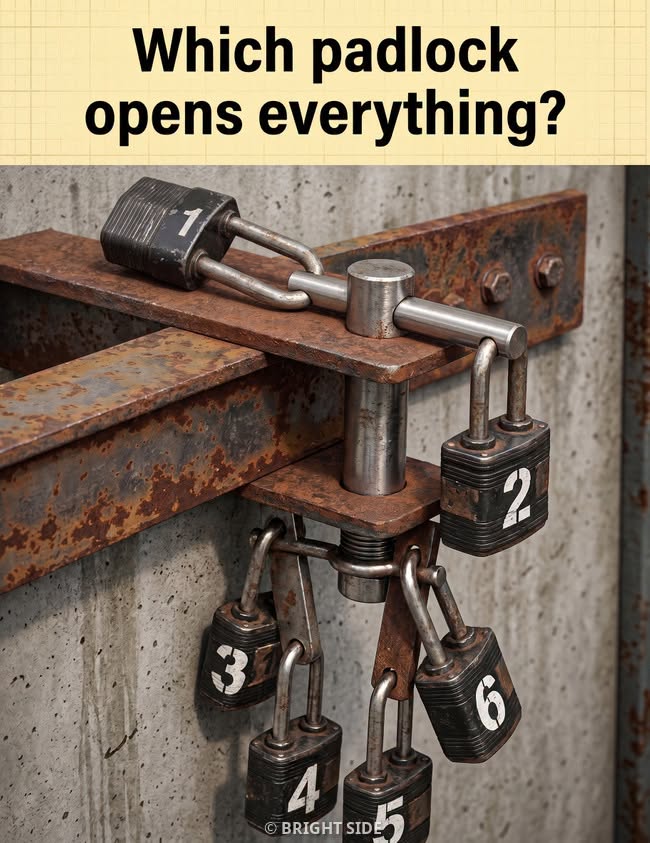
Mechanical riddles and linkage puzzles test visual analysis and spatial logic. In multi-lock security systems, finding the master or “linchpin” lock requires tracing how each shackle, ring, and bar physically interacts with the main locking mechanism.
In the puzzle graphic featured above, six numbered padlocks are attached to a heavy-duty metal pin assembly:
Header: “Which padlock opens everything?”
Visual Mechanics Breakdown:
Main Pin: A vertical steel bolt holding two metal plates together.
Top Crossbar: A horizontal steel cylinder passing through the top head of the main vertical pin.
Padlock 1: Connected directly through the left eyelet of the horizontal crossbar.
Padlock 2: Hanging off the right end of the horizontal crossbar.
Padlocks 3, 4, 5, 6: Suspended below the lower plate via interconnected links.
Visual Attribution:
Source: Courtesy of Bright Side.
In this guide, we analyze the mechanical linkage step-by-step to reveal which padlock unlocks the entire system.
Strategy Overview
+--------------------------------------------------------+
|                 Mechanical System Analysis             |
+---------------------------+----------------------------+
                            |
                            v
+--------------------------------------------------------+
|  Horizontal Crossbar      |  Vertical Pin Movement     |
|  - Holds vertical pin in  |  - Cannot drop while top   |
|    place                  |    crossbar is secured     |
|  - Padlock 1 secures left |  - Padlock 1 prevents bar  |
|    end to frame           |    sliding or releasing    |
+---------------------------+----------------------------+
                            |
                            v
+--------------------------------------------------------+
|  Core Objective                                        |
|  - Identify which lock release allows the main vertical|
|    pin to slide out and release the entire mechanism.  |
+--------------------------------------------------------+
Trace and Solve the Mechanism
To determine which padlock releases the entire lock assembly:
-
Analyze the Main Locking Pin:
-
The vertical steel cylinder holds the main structure together.
-
To open the mechanism, this vertical pin must drop downward or slide out of the top plate.
-
-
Examine the Top Retaining Crossbar:
-
A horizontal bar passes through the eyelet at the top of the main vertical pin, physically stopping it from sliding down through the plate.
-
On the right side of this horizontal bar hangs Padlock 2. Removing Padlock 2 simply detaches it from the bar, leaving the horizontal bar and main pin firmly locked.
-
On the left side, Padlock 1 directly loops through the eyelet/ring of the horizontal crossbar, tethering the entire top bar to the stationary bracket.
-
-
Examine the Lower Locks (3, 4, 5, 6):
-
Padlocks 3, 4, 5, and 6 are hanging from lower rings attached to the bottom section. Removing any of these lower locks only disconnects individual hanging components without releasing the main vertical pin or crossbar above.
-
-
Identify the Master Linchpin:
-
Opening Padlock 1 unhooks the top crossbar from the main bracket.
-
Once Padlock 1 is removed, the horizontal crossbar can be pulled out, allowing the vertical main pin to drop freely, instantly releasing all connected bottom plates and remaining padlocks.
-
Therefore, Padlock 1 is the master padlock that opens everything!
Lock Function Matrix
| Padlock Number | Attachment Point | Effect when Removed | Releases Assembly? |
| Padlock 1 | Top horizontal crossbar eyelet | Releases top bar; vertical pin drops free | YES (Opens Everything) |
| Padlock 2 | Right end of crossbar | Detaches Padlock 2 only | No |
| Padlocks 3 & 4 | Lower left ring assembly | Detaches lower left sub-loop | No |
| Padlocks 5 & 6 | Lower right ring assembly | Detaches lower right sub-loop | No |
Spatial Logic, Brain Health, and Problem Solving
Exercising physical logic and mechanical reasoning helps develop strong spatial visualization and analytical focus.
Engaging with visual puzzles directly supports cognitive health and mental agility. Developing keen observation skills benefits professionals in technical and business disciplines, helping individuals manage personal finance operations, audit complex systems, and maintain active problem-solving skills into retirement.
Tips for Solving Mechanical Linkage Puzzles
-
Locate the Primary Constraint: Identify the main pin, bolt, or latch holding the central structure together.
-
Trace the Dependency Chain: Work backward from the central constraint to see which lock directly holds the retaining bar or latch.
-
Ignore Distractor Links: Secondary locks attached to sub-rings often act as visual distractions that do not affect the main anchor.
Conclusion
Tracing the mechanical connections confirms that Padlock 1 secures the top crossbar holding the main vertical pin in place. Removing Padlock 1 releases the entire assembly!
Did you spot Padlock 1 as the key right away? Share your solution method in the comments below!
FAQ Section
Which padlock opens everything?
Padlock 1 opens everything because it holds the main horizontal crossbar that prevents the central locking pin from sliding out.
How do mechanical linchpin puzzles work?
They rely on a single primary retainer that locks all secondary links; releasing the primary retainer causes a chain reaction that frees the entire system.
