
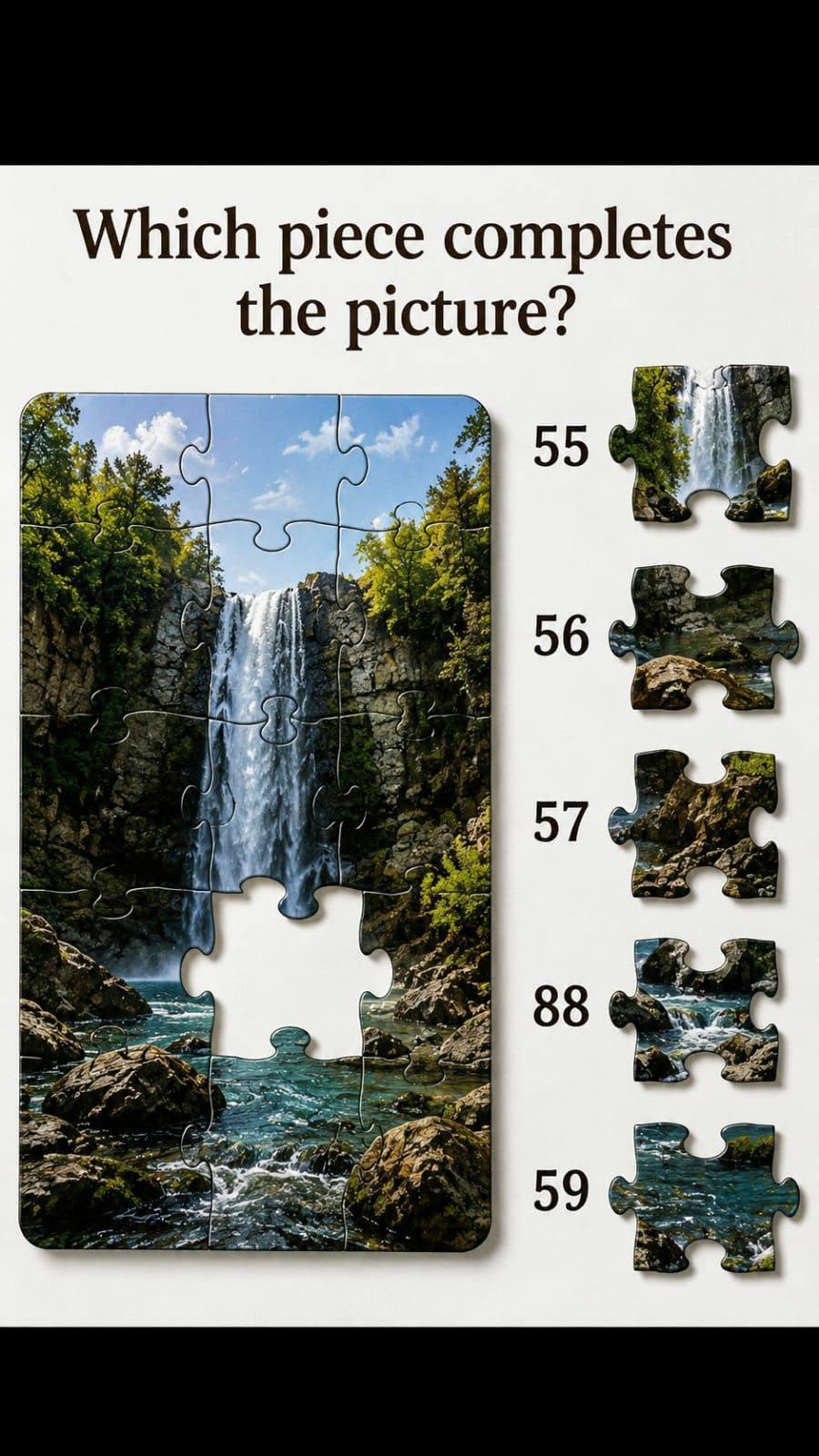
Visual puzzles and jigsaw teasers are a great way to test your pattern recognition and spatial reasoning skills. The challenge above shows a scenic waterfall landscape with one missing piece in the lower-middle section.
Analyzing the Missing Piece
To find the correct piece, we need to match both the connector shapes (tabs and slots) and the visual content of the image:
1. Edge & Connector Alignment
-
Top Edge: Requires a slot (hole) on top to receive the tab pointing down from the waterfall stream above it.
-
Bottom Edge: Requires a slot at the bottom to receive the rounded tab extending upward from the water below.
-
Left Edge: Needs a tab extending outward to fit into the hole on the left puzzle piece.
-
Right Edge: Needs a slot/hole to receive the tab extending from the right puzzle piece.
2. Image Content Match
-
The missing section sits right at the base of the main waterfall cascade where white rushing water meets the turquoise pool below.
-
The top half of the missing piece must feature the bottom vertical streams of the white waterfall, while the bottom portion shows the swirling water surface at the plunge pool.
Evaluating the Options
-
Piece 55: Contains the upper portion of the waterfall with trees, which belongs near the top of the image.
-
Piece 56: Shows dark rocky terrain without the central white water stream.
-
Piece 57: Contains dark cliffs and foliage, lacking the main waterfall stream down the middle.
-
Piece 88: Matches the required connectors perfectly and shows the falling white water converging into the lower pool.
-
Piece 59: Shows mostly dark water and lower pool reflections without the vertical white water streams needed at the top.
The Solution
Piece 88 is the correct piece to complete the picture.
Frequently Asked Questions (FAQ)
What skills do visual puzzle games improve?
Solving puzzle challenges regularly helps enhance pattern recognition, spatial awareness, attention to detail, and problem-solving speed.
How do you systematically solve missing puzzle piece teasers?
First, analyze the shape and orientation of the surrounding connectors (tabs and slots). Next, observe continuous color, texture, and line patterns across the border edges to eliminate incorrect options quickly.
