
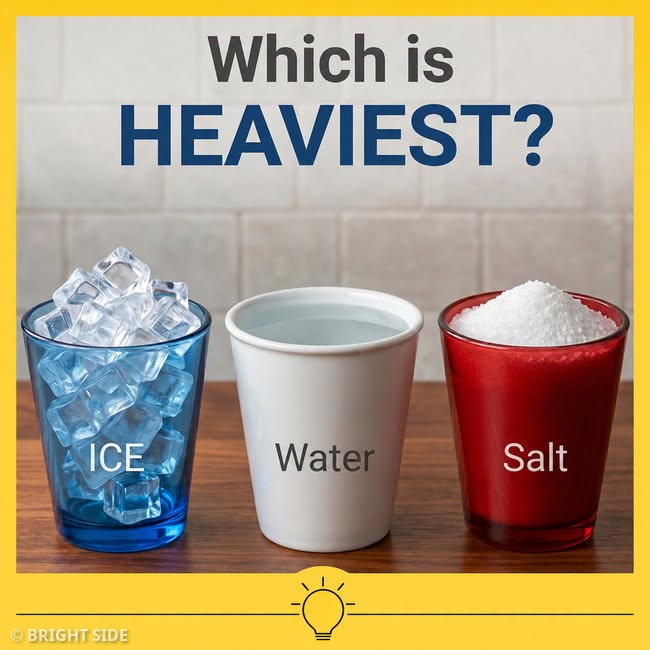
Riddles involving equal volumes of household substances are a classic way to test our understanding of density and weight. While three identical glasses might look equally full, the physical properties of the materials inside determine which one actually weighs the most on a scale.
In the puzzle image above, three identical cups are filled to the brim with different substances:
-
Glass 1 (Blue): Ice cubes
-
Glass 2 (White): Liquid water
-
Glass 3 (Red): Table salt (sodium chloride)
By examining density and packing efficiency, we can easily determine which glass is the heaviest.
Step-by-Step Breakdown
To solve this riddle, we must look at the density (mass per unit volume) of each material and how tightly it fills the glass:
1. Ice vs. Liquid Water
-
Density of Water: Liquid water has a density of approximately $1.0\text{ g/cm}^3$.
-
Density of Ice: When water freezes into ice, it expands and becomes less dense, with a density of about $0.92\text{ g/cm}^3$ (which is why ice floats in water).
-
Air Gaps: Ice cubes stacked in a glass leave significant air pockets between them. Liquid water fills the entire volume of the glass continuously.
-
Therefore, the glass of liquid water is noticeably heavier than the glass filled with ice cubes.
2. Table Salt vs. Water
-
Density of Table Salt: Table salt (sodium chloride) has a solid crystalline density of about $2.16\text{ g/cm}^3$—more than double that of liquid water!
-
Bulk Density: Even when granulated salt is poured into a cup with tiny air gaps between the grains, its bulk density remains roughly $1.2\text{ g/cm}^3$ to $1.3\text{ g/cm}^3$.
-
Because salt’s bulk density easily exceeds the density of liquid water ($1.0\text{ g/cm}^3$), the same volume of table salt weighs significantly more.
The Final Answer
Salt is the heaviest! Even accounting for the small air spaces between fine salt grains, the glass filled with salt has the highest total mass, followed by liquid water, with ice being the lightest.
Why Density Riddles Go Viral
-
Counterintuitive Physics: Many people forget that ice expands and becomes less dense than liquid water, creating an immediate trap for quick guessers.
-
Everyday Materials: Using familiar kitchen staples makes scientific concepts accessible and engaging to all ages.
-
Great Conversation Starter: Simple science teasers naturally prompt debates and quick classroom-style discussions on social media.
