
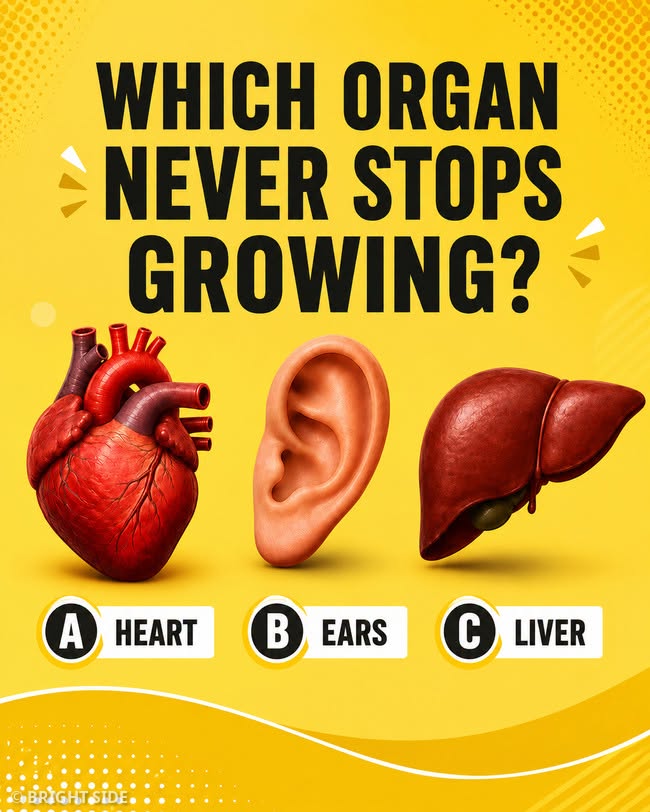
Human biology trivia questions frequently captivate social media audiences because they reveal surprising truths about how our bodies change as we age. While most human organs reach their full adult size during puberty or early adulthood, certain anatomical structures continue to expand due to gravity, cartilage changes, or unique tissue properties.
In the graphic above, three anatomical choices are presented:
-
A) Heart
-
B) Ears
-
C) Liver
By examining human anatomy and tissue growth, we can break down which option fits the legendary “never stops growing” phenomenon.
Step-by-Step Breakdown
Let’s evaluate the biological reality behind each choice:
1. Heart (Option A)
-
The human heart reaches its normal adult size in early adulthood.
-
While the heart muscle can enlarge (hypertrophy) due to high blood pressure, heart disease, or intense athletic training, this is a physiological response to stress rather than continuous healthy lifelong growth.
2. Liver (Option C)
-
The liver is famous for its remarkable ability to regenerate lost tissue after injury or surgery.
-
However, once it reaches its normal functional mass relative to body size, it stops growing and maintains a stable size unless damaged.
3. Ears (Option B)
-
Human ears (and noses) appear to continuously grow throughout our entire lives.
-
The Biological Reason: Ears are largely made of cartilage, surrounded by skin and connective tissue. As we age, collagen fibers lose elasticity, and the constant pull of gravity causes the cartilage structures to stretch and elongate—making ears measurably larger in older age.
The Final Answer
B) Ears! While driven primarily by the breakdown of elastic cartilage and gravity, human ears continue to expand and lengthen throughout a person’s lifespan.
Why Human Body Trivia Puzzles Go Viral
-
Relatable Aging Facts: Learning why our bodies change over time naturally piques human curiosity and leads to self-reflection.
-
Common Misconceptions: Distinguishing between muscular growth, tissue regeneration, and cartilage stretching sparks engaging medical debates.
-
Quick & Fun Participation: Simple multiple-choice formats encourage friends to test each other and share fun facts in the comment sections.
