
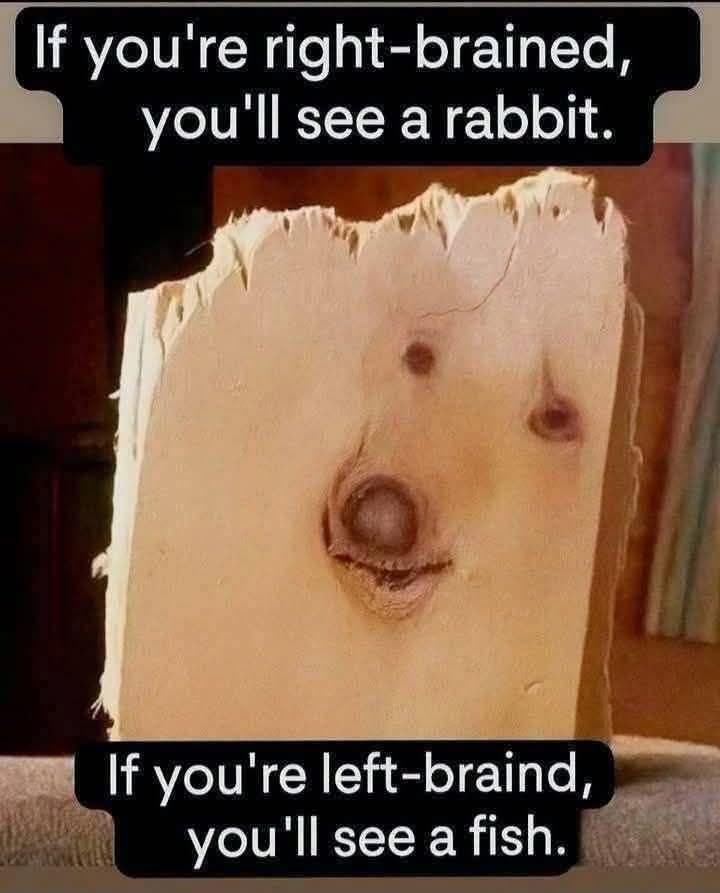
Optical Illusion Breakdown: Why Everyone Sees a Dog in This “Rabbit or Fish” Wood Knot
Viral brainteasers and psychological personality tests flood social media daily. A popular image shows a cut piece of wood with dark knots, accompanied by text claiming: “If you’re right-brained, you’ll see a rabbit. If you’re left-braind, you’ll see a fish.”
Despite the prompt directing viewers to find a rabbit or a fish, the vast majority of people immediately spot a clear image of a dog’s face (often resembling a Labrador or Golden Retriever).
In this guide, we will break down the visual components of this illusion, explain the psychological phenomenon behind it, and debunk common myths surrounding left-brain vs. right-brain dominance.
What Is Actually in the Image?
The image features a cross-section of a wooden plank or block where natural imperfections in the wood create a startlingly detailed animal portrait:
-
The Nose & Mouth: A prominent dark wood knot near the center forms the nose and muzzle of a dog.
-
The Eyes: Two smaller dark spots located above and to the right of the central knot form the eyes.
-
The Overall Shape: The lighter wood grain and outer edges mimic the soft head and ears of a retriever-type dog.
The prompt mentioning a “rabbit” or a “fish” is a classic trick designed to spark commentary and debate, as viewers search for shapes that aren’t immediately obvious while ignoring the clear canine face.
The Science of Pareidolia
The reason your brain instantly recognizes a face in a piece of wood is a neurological phenomenon known as pareidolia:
-
Evolutionary Survival: Human brains are hardwired from birth to recognize facial features (eyes, nose, and mouth) almost instantaneously. This mechanism evolved to help humans quickly identify friend, foe, or environmental hazards.
-
Pattern Seeking: When presented with random or ambiguous visual patterns—such as clouds, rock formations, or wood knots—the brain’s visual cortex attempts to make sense of the data by fitting it into familiar categories, predominantly human or animal faces.
Left-Brain vs. Right-Brain: Debunking the Myth
The claim that seeing certain shapes in an illusion proves “left-brain” or “right-brain” dominance is a widely repeated psychological myth:
| Myth vs. Fact | Common Claim | Neuroscientific Reality |
| Hemispheric Dominance | “Left-brained” people are purely logical; “right-brained” are creative. | Complex visual processing and perception recruit both hemispheres simultaneously via the corpus callosum. |
| Illusion Perception | What you see reveals your personality type. | Visual perception relies on pattern recognition and individual focus, not personality traits. |
Conclusion
Whether you see a dog, attempt to spot a hidden rabbit, or decode a fish, this optical illusion is a great demonstration of visual pareidolia in action!
Frequently Asked Questions (FAQ)
What is pareidolia?
Pareidolia is the psychological tendency to perceive a specific, often meaningful image (like a human or animal face) in random or ambiguous visual patterns, such as clouds, burnt toast, or wood grain.
Does seeing a specific shape in an optical illusion mean anything about your personality?
No. Personality tests based on initial visual perception in optical illusions are entertaining viral trends, but they lack scientific or psychological validity.
