
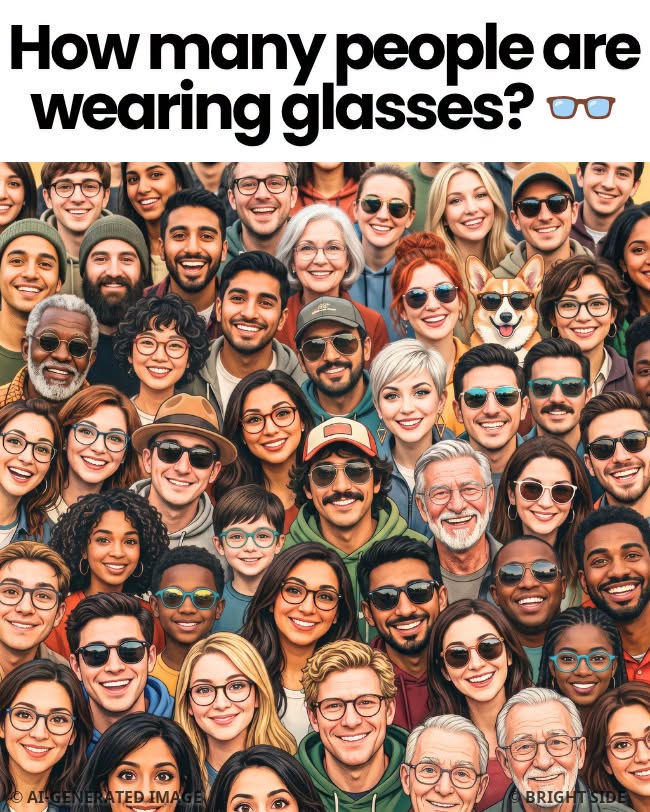
Crowd images and hidden-object puzzles have become a dominant trend across digital media, captivating millions of viewers who love testing their visual perception. When presented with a dense mosaic of faces—such as a vibrant crowd scene featuring diverse individuals, varied expressions, and subtle accessories—our brains undergo a complex neurological process to make sense of the visual data. This comprehensive guide explores the science of visual search, the mechanics of cognitive load, and practical strategies to enhance your attention to detail.
The Science of Visual Search
Visual search is the process of actively scanning our environment for a specific target among distractions. Psychologists divide this process into two primary mechanisms: pre-attentive processing and focused attention.
When you first glance at a crowded image, your brain instantly registers basic features like color, shape, and contrast without conscious effort. This pre-attentive stage allows you to spot standout elements, such as a bright yellow background or a distinct article of clothing. However, identifying specific, uniform details—like determining who is wearing glasses and who is not—requires focused, serial attention. Your brain must methodically isolate each face, scan the eyes, verify the presence of frames, and tally the results.
Cognitive Load and Selective Attention
Why do people often get different answers when counting items in a complex image? The answer lies in cognitive load theory and selective attention limits.
The Limits of Working Memory
Human working memory has a finite capacity. When faced with dozens of faces overlapping in a tight grid, it is remarkably easy to lose count or double-count individuals, especially when distractions like hats, beards, and varied lighting pull your gaze away.
Inattentional Blindness
When your focus is heavily invested in a specific task, your brain tends to filter out surrounding details to conserve mental energy. This phenomenon, known as inattentional blindness, explains why individuals scanning a crowd can easily overlook someone wearing subtle wire-rimmed glasses or mistake a pair of sunglasses for regular corrective lenses.
Practical Tips to Improve Your Visual Processing Skills
Enhancing your visual scanning and attention to detail benefits more than just puzzle-solving; it sharpens everyday focus, administrative accuracy, and situational awareness.
-
Scan in Grids: Instead of letting your eyes wander randomly across a complex image, divide the visual field into imaginary quadrants or vertical columns. Scan one section at a time systematically.
-
Filter by Features: Break down the overall goal into smaller criteria. For example, scan the image once to locate every face, and a second time specifically to inspect the bridge of the nose on each person.
-
Minimize Distractions: When tackling complex visual tasks, ensure your environment is free from external interruptions to keep your prefrontal cortex fully engaged.
-
Practice Mindfulness Exercises: Regular focus training helps expand your sustained attention span, reducing mental fatigue during detail-oriented work.
Interesting Facts About Human Perception
Our visual system is a marvel of evolutionary engineering, yet it is surprisingly easy to trick.
-
Saccadic Eye Movements: Human eyes do not glide smoothly across a scene; instead, they make rapid, jerky movements called saccades. We actually take in visual snapshots only during brief pauses between these movements.
-
Peripheral Limitations: Despite feeling like we see everything at once, our high-acuity central vision (the fovea) covers a very narrow angle. The rest of our field of view relies on low-resolution peripheral processing filled in by the brain.
-
Digital Puzzles and Virality: Bright Side and similar puzzle creators leverage these exact perceptual blind spots to design challenges that encourage social sharing, friendly debate, and high engagement online.
Conclusion
Visual puzzles like crowd counting challenges are a fun and effective way to test your cognitive agility. By understanding how your brain processes visual data, manages attention, and filters distractions, you can improve your observational skills and enjoy these brain teasers even more. Next time you tackle a crowd challenge, slow down, use a systematic grid approach, and see if you can spot every single detail without missing a beat.
Frequently Asked Questions
Why is it so easy to miss hidden details in crowd images?
Our brains rely on heuristics and shortcuts to process complex scenes quickly, which often leads us to gloss over subtle items like transparent eyeglass frames or small accessories tucked behind other elements.
Do visual puzzles help improve brain health?
Yes, engaging in regular visual search tasks and puzzles stimulates neural pathways, encourages neuroplasticity, and helps maintain cognitive flexibility and attention span.
How can I avoid double-counting people in complex photos?
Using a systematic scanning pattern—such as starting from the top left corner and working your way methodically across and down—greatly reduces the likelihood of counting the same individual twice.
