
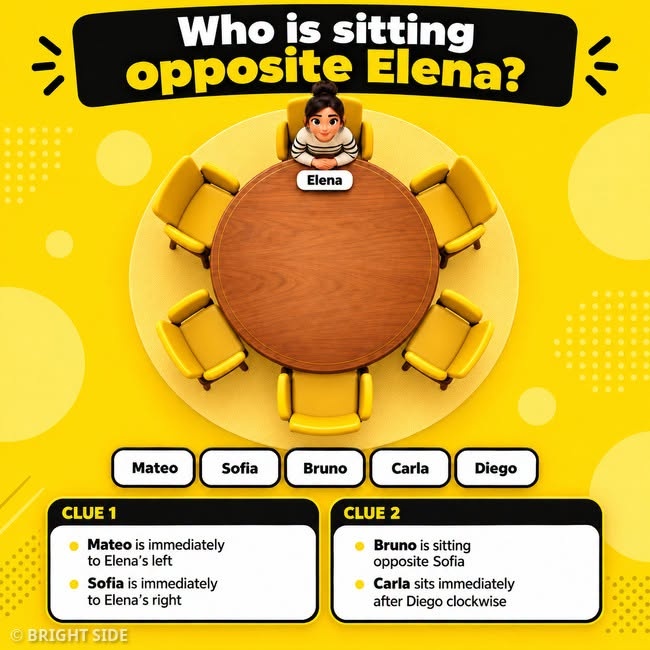
Logic riddles, seating arrangement puzzles, and deductive reasoning challenges are massive hits across social media, drawing thousands of comments, debates, and shares. These engaging brain teasers look simple at first glance, but they require a structured, step-by-step approach to solve correctly. Beyond providing quick entertainment, practicing logic puzzles offers profound benefits for cognitive flexibility, analytical precision, and mental longevity. This comprehensive guide explores the psychology of deductive puzzles, effective methods for solving spatial arrangement challenges, and the lifelong benefits of regular brain training.
The Psychology of Social Media Logic Puzzles
Why do seating arrangement riddles and deductive puzzles go viral online? The answer lies in the human brain’s love for structured problem-solving. When people encounter a puzzle with a clear set of clues, an intellectual challenge is instantly triggered.
Users enjoy testing their deduction skills against friends and other commenters. Because minor misinterpretations of words like “clockwise” or “left” can lead to incorrect conclusions, comment sections frequently fill up with passionate discussions and differing answers. This lively debate drives high engagement and virality across platforms like Facebook and Instagram.
Cognitive Benefits of Deductive Reasoning
Engaging in logic puzzles does much more than pass the time; it provides a rigorous workout for your prefrontal cortex, the area of the brain responsible for complex planning, working memory, and decision-making.
Enhancing Working Memory
Seating puzzles require you to hold multiple spatial constraints in your mind simultaneously. As you map out positions, your working memory tracks relationships, exclusions, and relative directions. Regular practice builds stronger neural pathways, improving your ability to manage complex information in professional and personal life.
Boosting Analytical Precision
Deductive reasoning relies on the process of elimination. By taking absolute truths from individual clues and stacking them together, you learn to discard false assumptions methodically. This skill translates directly to high-stakes fields such as finance, business logistics, legal analysis, and software troubleshooting.
Step-by-Step Breakdown: Solving the Seating Arrangement Puzzle
To master seating puzzles like the one featured in our image, you must approach the clues methodically using a systematic elimination framework. Let us break down how to solve who is sitting opposite Elena:
-
Establish Fixed Anchors: Identify any individual whose position is explicitly given. Here, Elena is seated at the top center of the circular table.
-
Analyze Immediate Neighbors (Clue 1):
-
“Mateo is immediately to Elena’s left.” Looking from Elena’s perspective facing the table, her left corresponds to the upper-left chair.
-
“Sofia is immediately to Elena’s right.” Elena’s right corresponds to the upper-right chair.
-
-
Incorporate Relational Clues (Clue 2):
-
“Bruno is sitting opposite Sofia.” Since Sofia is in the upper-right seat, the seat directly across (opposite) from her is the lower-left seat. Therefore, Bruno sits in the lower-left chair.
-
“Carla sits immediately after Diego clockwise.” Look at the remaining vacant chairs at the bottom and lower-right of the table. If Carla is immediately after Diego in a clockwise direction, Diego must occupy the bottom center chair, and Carla must occupy the lower-right chair.
-
-
Determine the Final Target: Look at the remaining open seat or map the opposite position across from Elena. With Mateo on the upper left, Sofia on the upper right, Bruno on the lower left, Diego at the bottom, and Carla on the lower right, the person sitting directly opposite Elena at the bottom center is Diego.
Practical Tips to Improve Your Logical Thinking
Sharpening your puzzle-solving abilities requires consistent, low-stress mental exercise. Small daily habits can yield noticeable improvements in cognitive speed.
-
Draw It Out: Never try to solve spatial puzzles entirely in your head. Use a piece of paper to sketch circles, draw chairs, and write down initials for each clue.
-
Break Clues into Small Rules: Translate complex sentences into bullet points or shorthand equations before attempting to place entities into a grid or diagram.
-
Double-Check Your Assumptions: Always verify your final arrangement against every single clue simultaneously to catch any minor directional errors.
-
Vary Puzzle Types: Alternate between numeric riddles, spatial logic games, and linguistic wordplay to ensure all cognitive domains remain active and challenged.
Interesting Facts About Logic Puzzles Through History
Logic puzzles have a rich history that spans centuries, evolving from ancient recreational pastimes into tools for modern cognitive science.
-
Lewis Carroll’s Contribution: The famous author of Alice’s Adventures in Wonderland, Charles Lutwidge Dodgson (Lewis Carroll), was also a pioneering mathematician who invented numerous symbolic logic games and puzzles.
-
The Zebra Puzzle: Often attributed to Albert Einstein, famous multi-variable elimination puzzles test whether a solver can deduce a complete solution using only a handful of descriptive constraints.
-
Digital Virality: Modern social media algorithms favor visual logic puzzles because they transcend language barriers, enabling users worldwide to collaborate, debate, and share solutions instantly.
Conclusion
Logic puzzles bridge the gap between playful recreation and powerful cognitive exercise. By transforming abstract rules into visual seating arrangements, they invite us to slow down, apply rigorous deduction, and enjoy the satisfaction of cracking a difficult problem. Whether you solve spatial riddles in seconds or map them out carefully on paper, keeping your mind active builds lasting mental agility. Keep challenging your perspective and enjoy the journey of lifelong problem-solving!
Frequently Asked Questions
Why are seating arrangement puzzles so tricky?
Seating puzzles require you to constantly shift your perspective between relative directions (left, right, opposite) and a fixed bird’s-eye view of the table, which can easily cause mental confusion if you do not sketch them out.
Do logic puzzles improve real-world problem-solving?
Yes, practicing deductive reasoning strengthens neural pathways associated with working memory, pattern recognition, and systematic troubleshooting, helping you approach complex real-world challenges with confidence.
How can I get better at solving visual logic tests?
The key is patience and notation. Always anchor known positions first, map relative directions carefully, and cross-reference your completed layout against every clue provided before finalizing your answer.
