
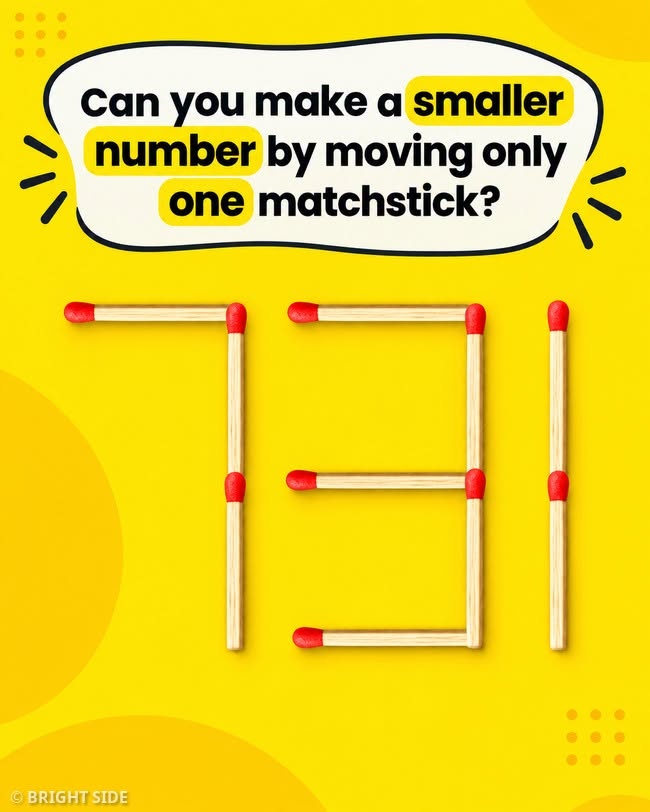
Matchstick puzzles and lateral thinking challenges have captured the global imagination, sweeping across social media feeds and drawing millions of comments, shares, and debates. These deceptively simple challenges test our visual cortex and cognitive flexibility, forcing us to rethink spatial configurations, rearrange geometric lines, and apply structured logic. Beyond mere entertainment, solving these puzzles provides profound benefits for mental acuity, lifelong learning, and cognitive longevity. This comprehensive guide explores the psychology of matchstick manipulation, analytical problem-solving strategies, and the cognitive rewards of keeping your mind sharp through tactile logic puzzles.
The Psychology Behind Viral Matchstick Puzzles
Why do matchstick puzzles go viral across Facebook, Instagram, and other digital platforms? The answer lies in human psychology and neurobiology. When individuals encounter a visual puzzle that presents a clear setup—such as numbers formed by matchsticks—a cognitive challenge is instantly triggered. People love to test their lateral thinking precision against friends, family, and online communities.
This desire for self-assessment and friendly competition drives massive engagement. Platforms that reward community interaction thrive on these visual puzzles. Moreover, solving a quick matchstick riddle provides a miniature dopamine reward, reinforcing curiosity and encouraging users to seek out more intellectual challenges. In an era dominated by rapid scrolling, matchstick puzzles act as a welcome mental speed bump, inviting deep engagement and conversation.
Cognitive Benefits of Regular Lateral Thinking Training
Engaging with matchstick puzzles and lateral thinking challenges is far more than a passing distraction; it is a powerful workout for the brain. Just as physical exercise strengthens muscle fibers, mental stimulation promotes neuroplasticity—the brain’s ability to reorganize itself by forming new neural connections.
Enhancing Working Memory and Attention
Puzzles require you to hold multiple variables in your mind simultaneously. When visualizing how moving a single matchstick alters an entire number, your working memory tracks configurations, geometry, and numerical value. Regularly challenging this mental workspace improves your overall capacity to retain information, focus on complex tasks, and filter out distractions in everyday life.
Boosting Analytical Thinking and Logic
Visual and tactile tracking is foundational to structured decision-making. Whether you are navigating logistics, managing daily schedules, or solving complex problems, the ability to mentally rearrange components and verify outcomes is invaluable. Puzzles train your brain to identify patterns, test hypotheses, and deduce correct solutions methodically.
Step-by-Step Analytical Breakdown: How to Solve Matchstick Puzzles
To master matchstick puzzles like the one featured in our image, you must approach them by evaluating how individual digits can be transformed with a single move. Let us break down the exact methodology needed to find the correct solution efficiently.
-
Analyze the Starting Number: Examine the given number formed by the matchsticks in the image (such as 731) and note the total number of digits and matchsticks.
-
Evaluate Potential Transformations: Consider how moving a single matchstick can change one digit into another (for example, turning a 3 into a 2 or a 5, or altering the leading digit).
-
Test the Condition: The puzzle asks how to make a smaller number by moving only one matchstick. Identify which shift reduces the overall numerical value most effectively.
-
Verify and Conclude: Confirm that your proposed rearrangement adheres strictly to the rule of moving only a single matchstick while successfully creating a valid, smaller number.
Applying this rigorous framework ensures you arrive at the correct answer every single time, avoiding common traps caused by visual misinterpretation.
Practical Tips for Keeping Your Mind Sharp
Incorporating cognitive exercises into your daily routine does not require hours of complex study. Small, consistent habits can yield remarkable improvements in mental agility and visual processing speed.
-
Dedicate Ten Minutes Daily: Set aside a brief window each morning to tackle a visual puzzle or lateral thinking riddle before diving into high-stress tasks.
-
Vary the Difficulty: Alternate between matchstick puzzles, spatial reasoning tasks, and verbal riddles to ensure different regions of the brain receive balanced stimulation.
-
Explain Your Reasoning: Teach or explain how you solved a puzzle to someone else. Articulating your steps solidifies your understanding and uncovers hidden gaps in logic.
-
Embrace Mistakes: Treat incorrect guesses as valuable learning moments rather than failures. Analyzing why an initial assumption was wrong builds stronger critical thinking pathways.
Interesting Facts About Matchstick Puzzles Through History
Puzzles involving matches and geometric sticks are far from a modern internet phenomenon; they are deeply rooted in human history, recreational mathematics, and puzzle literature.
-
Victorian Origins: Matchstick puzzles gained widespread popularity during the Victorian era, appearing in parlor games and recreational mathematics books as an accessible way to test logic.
-
Mathematical Flexibility: Mathematically, matchsticks act as binary segments that can be added, removed, or relocated to explore topology and numerical changes instantly.
-
Digital Virality: Modern social media algorithms favor visual puzzles because they transcend language barriers, allowing a single image to engage millions of users globally within hours.
Conclusion
Matchstick puzzles bridge the gap between entertainment and cognitive enhancement. By transforming basic arithmetic and geometry into an engaging challenge, they invite us to exercise our analytical muscles, spark lively discussions, and enjoy the satisfaction of cracking a tough problem. Whether you solve them in seconds or deliberate over the movable sticks, the mental benefits of staying curious are undeniable. Keep challenging your mind, explore new varieties of puzzles, and let curiosity guide your journey toward sharper critical thinking.
Frequently Asked Questions
Why do matchstick puzzles trick our brains so easily?
Our brains rely on evolutionary shortcuts called heuristics to process visual numbers instantly. When an image asks us to alter a number with a single move, our minds get locked into the existing configuration, making lateral thinking essential.
Do visual puzzles actually improve cognitive function?
Yes, regularly engaging in complex visual problem-solving stimulates neuroplasticity, enhances working memory, and sharpens analytical thinking skills across all age groups.
How can I get better at solving matchstick riddles?
The key is patience and systematic testing. Mentally remove or shift one stick at a time rather than trying to guess the final configuration all at once.
