
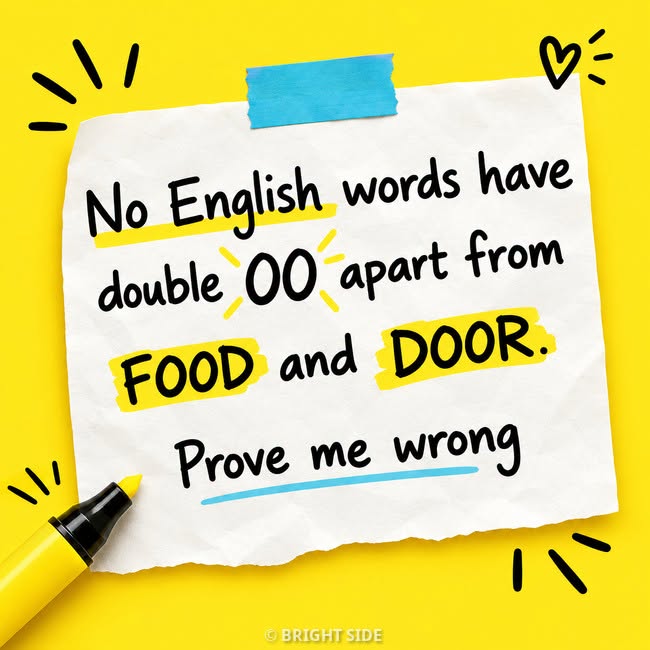
Every few months, a viral graphic sweeps across social media feeds, catching thousands of users off guard. Written in bold marker across a bright yellow backdrop, the statement boldly claims: “No English words have double ‘OO’ apart from FOOD and DOOR. Prove me wrong.” At first glance, your mind might race for a split second, momentarily stumped. However, within milliseconds, common daily words like “book,” “look,” or “good” inevitably pop into your head.
So why do blatant misinformation posts like this go wildly viral online, gathering tens of thousands of comments, shares, and debates? The secret lies in cognitive psychology, viral engagement tactics, and the intriguing mechanics of the English language. In this article, we will completely debunk this myth, explore the linguistic mechanics of double-vowel spellings, reveal how these terms impact diverse professional fields, and analyze why your brain reacts to viral challenges so intensely.
Debunking the Myth: The Reality of Double “O” Words
To put it directly: the claim that “food” and “door” are the only double “O” words in English is entirely false. In fact, double “O” is one of the most common letter combinations in written English. Linguists estimate that there are well over 1,000 words in the English dictionary containing consecutive “O”s.
The viral graphic operates on a well-known psychological phenomenon called “rage baiting” or “cognitive correction.” By stating something so demonstrably wrong with supreme confidence, the post triggers an irresistible urge in readers to jump into the comment section to correct the author. This flood of comments tricks social media algorithms into thinking the post contains critical, high-value conversation, prompting the platform to show it to millions of additional users.
Everyday Double “O” Words You Use Constantly
To highlight just how widespread this letter pairing is, you only need to look around your room or recall basic daily activities:
Home & Architecture: Floor, roof, room, stool, spoon, broom, boot, hook, tool, pool.
Nature & Environment: Moon, wood, flood, brook, root, zoo.
Human Anatomy: Foot, tooth, blood, mood.
Daily Actions: Look, cook, choose, shoot, zoom, boot, boom, coop, swoop.
Culture & Media: Book, school, cartoon, smooth, groove, spoof.
Linguistic Evolution: How Double “O” Developed in English
To understand why double “O” is so widespread, we have to look back at the history of the English language. English is a Germanic language that heavily absorbed influences from Old Norse, French, and Latin over centuries. During the Middle English period (1100–1500 AD), scribes used double vowels to represent long vowel sounds.
However, between the 14th and 18th centuries, the Great Vowel Shift fundamentally changed how spoken English sounded. As speakers shifted their mouth positions for long vowels, the written spelling of “OO” remained frozen, while its actual pronunciation fractured into several distinct phonetic groups.
The 4 Phonetic Sounds of Double “O”
The Long /uː/ Sound: Heard in food, moon, smooth, tool, snooze.
The Short /ʊ/ Sound: Heard in book, good, foot, wood, took.
The Open-Mid /ɔː/ Sound: Heard in door, floor, moor, poor.
The Short /ʌ/ Sound: Heard in blood, flood.
Specialized Double “O” Terms Across Professional Sectors
Beyond everyday speech, words featuring double “O” play a vital role in professional terminology across business, legal, financial, and technical industries.
1. Technology and Innovation
Modern technology relies on terms like bootstrapping, developer toolkits, boolean logic, and web scraping. Major tech brands like Google and Yahoo have built global empires on names centered around the double “O.” Furthermore, virtual video conferencing tools like Zoom have transformed modern business operations.
2. Finance, Loans, and Real Estate
In the world of finance, investors talk about economic booms, cash flow boosts, and structural market shifts. When purchasing real estate, buyers secure a mortgage or personal loan to acquire homes featuring solid wood floors and updated roofs. Financial advisors stress the importance of building a steady credit score and protecting your retirement portfolio through smart investment strategies.
3. Medical, Health, and Legal Services
In healthcare, medical professionals treat conditions involving blood pressure, foot care, and dental health. Patients recovering from illness depend on proper whole-food nutrition and quality rest to improve their overall wellness. Should issues arise with coverage, consulting an attorney specializing in insurance or legal services ensures your rights remain protected.
Practical Tips for Improving Vocabulary and Digital Literacy
Viral language riddles provide a great opportunity to reflect on how we consume content online and sharpen our mental acuity. Here are practical ways to enhance your linguistic skills and digital hygiene:
Practice Active Reading: Engage daily with high-quality literature, news, and specialized journals. Broader reading habits expand your active vocabulary and strengthen written communication skills.
Study Etymology: Learn common Latin and Greek root words. Recognizing root structures helps you quickly decipher complex terms in professional and academic environments.
Verify Before Reacting: When you see sensational graphics or claims online, take five seconds to double-check the facts before commenting or sharing. Recognizing engagement traps keeps your feed focused on genuine information.
Enroll in Lifelong Education: Continuous learning through online education platforms or writing workshops can dramatically improve your professional career prospects and vocabulary retention.
Fascinating Facts About English Double Letters
The Triple Double Word: The word Bookkeeper (and bookkeeping) is the only common, unhyphenated English word containing three consecutive pairs of double letters (OO – KK – EE).
The Longest Vowelless Word: Rhythms is widely considered the longest standard English word without any of the traditional vowels (A, E, I, O, U).
Most Frequent Double Letter: Statistically, double “L” is the most frequent double letter pairing in the English language, closely followed by double “E” and double “O.”
Conclusion
The claim that “food” and “door” are the only double “O” words in the English language is completely false. From basic words like “book,” “floor,” and “moon” to complex terminology across technology, finance, health, and legal sectors, the double “OO” letter pair is an integral part of modern speech.
While graphics like this are designed primarily to bait user comments and drive algorithm performance, they also serve as a fun reminder of how rich, complex, and surprising the English language continues to be.
FAQ Section
Why do engagement posts use false statements on social media?
Creators intentionally post obvious errors because humans have a strong natural urge to correct mistakes. This generates high comment counts, which signals to platform algorithms that the post should be pushed to a broader audience.
What is the most common double letter in English?
Statistically, double “L” appears most frequently in written English prose, followed by double “E”, double “S”, and double “O”.
Are “blood” and “flood” pronounced differently than “food”?
Yes. While “food” uses a long /uː/ sound, “blood” and “flood” shifted historically to use a short /ʌ/ sound, making them rhyme with “mud” and “cup.”
