
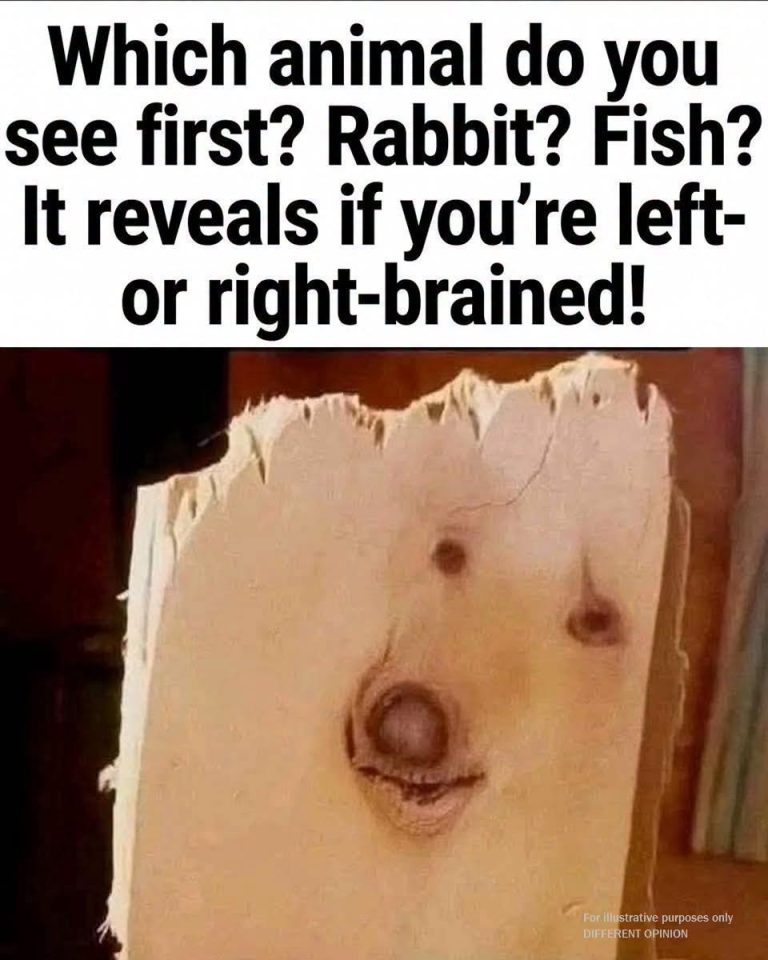
Optical illusions and projective visual tests have long captivated human interest, blending psychology, neuroscience, and fun self-discovery. When looking at an ambiguous image—such as a piece of wood whose natural knots, grain patterns, and textures resemble a rabbit or a fish—your brain instantly works to resolve the ambiguity. This rapid processing mechanism relies on pareidolia, the natural human tendency to perceive familiar faces or animal shapes in random visual patterns.
Popular personality tests often claim that whether you see a rabbit or a fish first reveals whether you are “left-brained” (analytical and logical) or “right-brained” (creative and intuitive). While modern neuroscience views brain lateralization through a far more nuanced lens, exploring the psychology behind visual perception provides fascinating insights into how we interpret information, solve problems, and perceive the world around us.
Decoding the Illusion: Rabbit vs. Fish
Ambiguous figures force the brain’s visual cortex to choose a primary visual interpretation. Depending on which shapes, angles, and light highlights your eyes register first, a distinct animal form emerges from the natural wood grain.
Seeing the Rabbit First: Analytical and Detail-Oriented Processing
If your eyes immediately framed the top section as long ears and the dark knot as a dark eye or nose, you likely perceived a rabbit.
-
Cognitive Tendencies: People who spot the rabbit first often possess strong linear processing skills. They excel at breaking down complex visual structures into distinct individual components before assembling the complete picture.
-
Personality Characteristics: Highly organized, methodical, and detail-oriented, rabbit perceivers often prefer structured environments, logical problem-solving, and clear step-by-step methodologies in their personal and professional lives.
Seeing the Fish First: Holistic and Intuitive Perception
If your brain recognized the overall oval outline, interpreting the knots as fins, gills, or a mouth swimming vertically or horizontally, you saw a fish.
-
Cognitive Tendencies: Seeing the fish first suggests a strong preference for spatial, holistic processing. Instead of analyzing individual knots first, your visual system synthesized the entire shape at once to form a complete animal silhouette.
-
Personality Characteristics: Fish perceivers are often described as creative, highly intuitive, and adaptable. They tend to see the “big picture” easily, excel at creative problem-solving, and thrive in dynamic environments requiring flexible thinking.
The Left-Brain vs. Right-Brain Popularity vs. Scientific Reality
The popular concept of left-brain vs. right-brain dominance stems from mid-20th-century neurological research. While the concept offers a convenient way to categorize thinking styles, real brain anatomy is far more interconnected.
| Brain Aspect | Left-Brain Popular Concept | Right-Brain Popular Concept | Modern Neuroscience View |
| Primary Focus |
Logic, math, analytical reasoning |
Creativity, intuition, art, spatial awareness |
Both hemispheres work together continuously via the corpus callosum |
| Language & Speech | Concentrated in left hemisphere (Broca/Wernicke) | Tone, rhythm, and emotional nuance | Left handles syntax/words; right handles emotion and context |
| Visual Processing |
Focuses on details and individual elements |
Synthesizes overall shapes and spatial patterns |
Both hemispheres process visual cues in rapid, parallel coordination |
Practical Tips for Enhancing Cognitive Flexibility and Creativity
Training your brain to switch between detail-oriented focus and big-picture creativity improves decision-making and cognitive agility in daily life:
-
Practice Mindful Observation: When looking at ambiguous visual patterns or art, consciously challenge yourself to search for alternative shapes, angles, and hidden figures.
-
Engage in Dual-Style Activities: Combine logical puzzles (like Sudoku or coding) with creative pursuits (like painting, musical improvisation, or creative writing) to engage diverse neural networks.
-
Change Perspective Under Pressure: When solving a difficult problem at work or home, alternate between zooming in on specific details and stepping back to view the entire system.
-
Embrace Pareidolia as a Creative Tool: Artists and designers often use natural textures, cloud shapes, or wood grain patterns to spark fresh ideas and unlock creative inspiration.
-
Get Quality Sleep for Cognitive Balance: Sleep plays a critical role in consolidating memories, clearing cellular waste, and allowing both brain hemispheres to communicate effectively.
Fascinating Facts About Visual Perception and Psychology
-
Pareidolia: The psychological phenomenon of seeing faces or animals in non-living objects (like clouds, rock formations, or wood knots) is an evolutionary adaptation that helped early humans quickly detect potential predators or allies in nature.
-
The Rabbit-Duck Classic: One of the most famous optical illusions in history is Jastrow’s Rabbit-Duck, published in 1899, which demonstrated that the human mind can see two completely different images in the exact same drawing depending on expectation.
-
Neural Speed: The human brain can process an entire image seen for as little as 13 milliseconds, identifying objects and emotional contexts almost instantaneously.
Education, Career, Financial Planning, and Business Growth
Understanding cognitive styles and perception plays a crucial role in modern education, workplace dynamics, and business management. Diverse teams that combine analytical, detail-oriented thinkers with intuitive, big-picture strategists consistently outperform uniform groups in complex problem-solving.
As professionals advance in their careers or manage business enterprises, leveraging different cognitive strengths becomes vital for financial success. Whether securing business investment loans, navigating commercial real estate mortgages, reviewing legal contracts with specialized attorneys, or managing long-term retirement portfolios, balancing rigorous analytical risk assessment with creative strategic vision ensures sustainable growth and lasting financial stability.
Conclusion
Whether you saw a rabbit or a fish first in the natural contours of the wood grain, optical illusions offer a delightful reminder of how uniquely each mind processes visual information. By appreciating both detail-oriented logic and intuitive big-picture vision, we can cultivate greater cognitive flexibility and approach life’s challenges from multiple creative angles.
Frequently Asked Questions (FAQ)
What causes people to see different animals in the same image?
Differences in initial visual focus, light reflection, personal experiences, and individual visual processing speeds lead different visual cortexes to highlight different shapes first.
Is the left-brain vs. right-brain personality theory scientifically accurate?
While certain functions (like language) are localized to specific brain regions, modern neuroimaging shows that healthy individuals use both brain hemispheres equally in unified coordination, disproving the idea that people are strictly “left-brained” or “right-brained”.
What is pareidolia?
Pareidolia is a harmless psychological phenomenon where the brain identifies recognizable patterns, faces, or shapes in ambiguous visual stimuli—such as seeing a face in a toaster or an animal in wood grain.
Can training improve my ability to see visual illusions faster?
Yes. Practicing visual puzzles, studying figure-ground perception, and engaging in artistic observation can train your brain to identify visual patterns and switch between competing interpretations more rapidly.
