
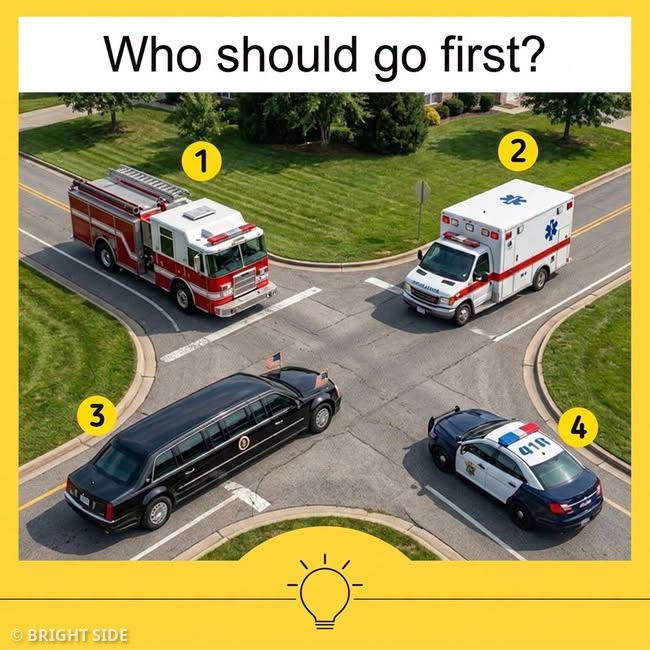
Navigating intersections requires a clear understanding of traffic laws, situational priority, and emergency vehicle protocols. When multiple vehicles arrive at a four-way intersection simultaneously, driver confusion can quickly lead to gridlock or hazardous situations. The complexity increases significantly when emergency response vehicles—such as fire trucks, ambulances, and police cars—are involved alongside VIP motorcades or executive transports.
The scenario illustrated above presents a classic traffic puzzle: a fire truck (1), an ambulance (2), a presidential or official limousine (3), and a police cruiser (4) all meeting at an intersection. Determining who should proceed first involves assessing standard traffic laws, active emergency signals, and statutory right-of-way hierarchies. In this comprehensive guide, we will break down the rules of road priority, analyze how emergency vehicles operate under statutory law, and explore practical traffic safety guidelines to ensure smooth and lawful driving.
1. Understanding Right-of-Way Rules and Priority Hierarchies
Traffic regulations are designed to minimize conflict and establish clear protocols when vehicles converge. Standard right-of-way rules provide a structured framework, but these rules yield to specialized emergency provisions under specific legal conditions.
Standard Uncontrolled Intersection Rules
At a standard four-way intersection without traffic lights or yield signs, general driving principles apply:
-
First to Arrive, First to Proceed: The vehicle that reaches the stop line or intersection first holds primary right of way.
-
The Yield-to-Right Rule: If vehicles arrive at the exact same time, drivers must yield to the vehicle on their immediate right.
-
Straight Movement Over Turning: Vehicles continuing straight typically have priority over those turning across oncoming traffic lanes.
+------------------------+-----------------------------------+-----------------------------------+
| Vehicle Type           | Standard Status                   | Emergency/Priority Condition      |
+------------------------+-----------------------------------+-----------------------------------+
| 1. Fire Truck          | Heavy Response / Rescue Vehicle   | Immediate Priority (Active Sirens)|
| 2. Ambulance           | Emergency Medical Response        | Immediate Priority (Active Sirens)|
| 3. Official Limousine  | VIP / Presidential Transport      | Priority only with Police Escort |
| 4. Police Cruiser      | Law Enforcement / Escort Vehicle  | Priority with Sirens or Escorting|
+------------------------+-----------------------------------+-----------------------------------+
2. Analyzing the Intersection Puzzle Scenario
To determine who goes first in the visual riddle provided, we must evaluate the legal status of each vehicle operating on public roadways.
Evaluating Active Emergency Response
Under standard motor vehicle codes, emergency vehicles—including fire engines, ambulances, and police cruisers—are granted absolute right of way only when actively responding to an emergency with illuminated emergency lights and active sirens.
-
Fire Truck (1) and Ambulance (2): Fire apparatus and emergency medical services (EMS) units engaged in life-saving calls hold top statutory priority. When sirens and emergency lights are engaged, all standard civilian traffic must yield immediately. Between active emergency units, priority is usually dictated by arrival time, specific dispatch protocols, or clear signaling between drivers.
-
Police Cruiser (4): A police car operating with active emergency signals holds equal emergency status to a fire engine or ambulance. However, if the police cruiser is actively escorting a diplomatic or presidential motorcade, it acts as the lead tactical unit clearing the intersection for the motorcade.
-
Official Limousine (3): An official executive transport car (such as a presidential state car or official vehicle displaying flags) does not automatically hold legal right of way on public streets by itself unless accompanied by an active police escort with activated emergency signals. If accompanied by lead police units clearing traffic, the entire motorcade proceeds as a single tactical movement.
The Correct Sequence Breakdown
Assuming all three emergency vehicles (Fire Truck, Ambulance, Police Car) are actively responding to emergency calls or managing a tactical escort:
-
Emergency Hierarchy: Fire trucks and ambulances responding to immediate life-threatening events (fires, structural rescues, or medical crises) generally take precedence due to the size of the vehicle and the critical nature of life-safety operations.
-
Motorcade Escort Protocol: If the police cruiser (4) is actively securing an official presidential route, police authorities clear the intersection entirely before vehicle (3) proceeds.
-
Standard Resolution: If sirens are off for all vehicles, normal right-of-way rules apply based on yielding to the right or established traffic signs.
3. Road Safety, Executive Protection, and Civic Infrastructure
Maintaining clear, safe roadways requires coordinated investments across public safety infrastructure, urban planning, and emergency service management. Efficient emergency response times directly impact community safety, healthcare outcomes, and property preservation.
Public Safety Infrastructure and Financial Risk Management
Emergency management systems rely on robust public funding, technological coordination, and comprehensive risk mitigation strategies. Municipal investments in traffic control technology—such as signal preemption devices that turn traffic lights green for incoming fire trucks and ambulances—significantly reduce collision risks at busy intersections.
Protecting civic infrastructure and public safety fleets involves complex financial planning. Municipalities and emergency response organizations maintain specialized municipal Insurance coverage to safeguard against vehicle damage and operational liability. Managing large public service fleets requires careful budgeting, competitive Credit structuring, and prudent capital allocation similar to managing a commercial Business or evaluating a long-term Investment.
When specialized legal issues arise regarding traffic accidents involving municipal vehicles, official motorcades, or personal injury claims, municipal entities and private citizens alike rely on specialized Legal Services and the counsel of a skilled Attorney to navigate statutory immunity, insurance claims, and legal liability.
Furthermore, public safety readiness is deeply tied to broader economic health. From funding local Education programs for paramedic training to securing a home Mortgage or personal Loan to reside in safe, well-serviced communities, public infrastructure forms the foundation of individual and family well-being. Ensuring comprehensive healthcare access through dedicated Health coverage and planning for long-term security in Retirement are essential steps toward individual financial stability.
4. How Drivers Should Respond to Emergency Vehicles on the Road
Knowing how to react when encountering emergency vehicles at an intersection prevents accidents and allows first responders to reach their destinations quickly.
Essential Driving Guidelines
-
Pull Over to the Right: Upon hearing a siren or seeing flashing lights, safely merge to the right edge of the roadway and come to a complete stop.
-
Do Not Block Intersections: If you are stopped in the middle of an intersection when an emergency vehicle approaches, carefully clear the intersection before pulling over to the right.
-
Stay Alert at Red Lights: Never run a red light or drive recklessly into oncoming traffic to get out of the way of an emergency vehicle; proceed only when it is safe to clear a path.
-
Maintain Distance: Follow emergency vehicles at a safe distance (typically at least 300 to 500 feet, depending on local traffic laws) to avoid interfering with emergency operations.
Interesting Facts About Traffic Laws and Emergency Protocols
-
Signal Preemption Systems: Many modern traffic signals are equipped with optical or radio sensors (such as Opticom systems) that detect approaching emergency vehicles and automatically change traffic lights to green.
-
The “Move Over” Law: In many jurisdictions, laws mandate that drivers slow down and change lanes when passing stationary emergency vehicles parked on the side of the road with activated lights.
-
Sirens and Audibility: The acoustic design of modern emergency sirens uses fluctuating frequencies (such as “wail” and “yelp” modes) specifically calibrated to penetrate soundproofing in modern passenger cars.
Conclusion
Determining who goes first at a busy intersection comes down to understanding the legal classification of each vehicle and whether emergency response protocols are active. Active emergency vehicles—such as fire trucks, ambulances, and police cars—hold statutory right of way over standard traffic to protect human life and property. By staying informed on driving laws and remaining attentive behind the wheel, drivers can keep intersections safe and ensure emergency responders reach their destinations without delay.
Frequently Asked Questions (FAQ)
Who has the absolute right of way at an intersection?
No driver has an “absolute” right of way; right of way is always granted by law based on specific conditions, such as arrival order, yielding to the right, or active emergency status.
What should you do if an ambulance approaches from behind while you are stopped at a red light?
If safely possible, pull as far to the right side of your lane as you can without entering the active cross-traffic lanes. Stay stopped and allow the emergency vehicle to maneuver around you.
Does an official limousine always have priority over standard cars?
No. An official limousine or state vehicle only holds priority over standard traffic if it is traveling as part of an official, active police escort with activated emergency signals.
