
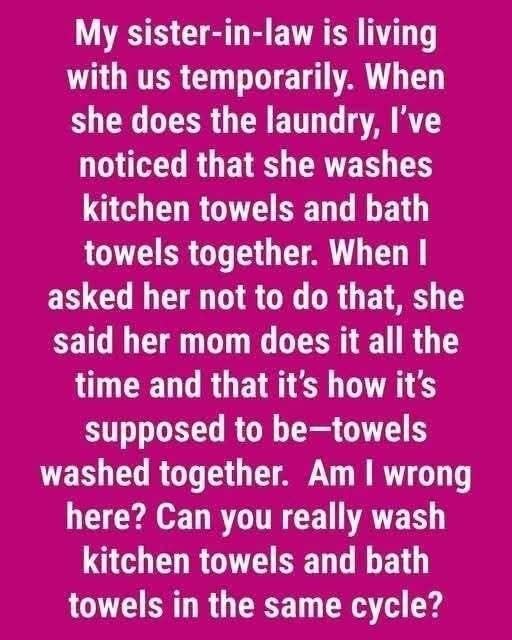
Is It Okay to Wash Kitchen Towels and Bath Towels Together? Laundry Hygiene Rules Explained
Household habits often lead to debate when living under one roof. A viral post recently sparked a major laundry discussion: “My sister-in-law is living with us temporarily. When she does the laundry, I’ve noticed that she washes kitchen towels and bath towels together… Am I wrong here? Can you really wash kitchen towels and bath towels in the same cycle?”
While grouping all items made of terry cloth into a single “towel load” seems convenient, experts in home hygiene and microbiology generally advise keeping kitchen linens separate from bath linens.
In this guide, we will break down the cross-contamination risks, explain the science behind laundry hygiene, and share best practices for sanitizing household towels.
Why You Should Keep Kitchen and Bath Towels Separate
Mixing kitchen dishcloths with bathroom bath towels introduces distinct types of bacteria and residue that are best kept apart:
1. Cross-Contamination of Bacteria
-
Kitchen Towels: Frequently harbor food-borne pathogens like E. coli, Salmonella, grease, and food particles from drying hands, wiping counters, and handling raw meat.
-
Bath Towels: Collect skin cells, body oils, fungi, and bacteria associated with personal hygiene (such as Staphylococcus).
When washed together in warm or cold water, bacteria can transfer between items during the wash cycle.
2. High Heat & Sanitize Requirements
Kitchen towels usually require hot water cycles ($140^\circ\text{F} / 60^\circ\text{C}$ or higher) or bleach to break down food oils and eliminate food-borne pathogens. Bath towels, especially plush or colored cotton, can deteriorate or fade quickly under high heat or aggressive bleaching.
3. Grease and Odor Transfer
Cooking oils and food residues from dish towels can transfer onto bath towels, leaving them smelling stale or reducing their absorbency over time.
Towel Care & Hygiene Comparison Matrix
| Aspect | Kitchen Towels | Bath Towels |
| Primary Contaminants | Food debris, cooking grease, E. coli, Salmonella | Body oils, dead skin cells, dampness, fungi |
| Recommended Wash Temp | Hot water ($140^\circ\text{F}$) with sanitize or bleach option | Warm water to protect fibers and colors |
| Wash Frequency | Every 1–2 days (or after handling raw food) | Every 3–4 uses |
| Drying Requirement | High heat (must be 100% dry to avoid bacteria) | Tumble dry medium/high |
How to Wash Towels Safely If You Must Mix Loads
If water usage or small load size requires combining linens, follow these sanitization steps to ensure thorough cleaning:
-
Use Hot Water: Always select a hot water cycle ($140^\circ\text{F}$) to kill bacteria across both towel types.
-
Add a Laundry Sanitizer: Use a chlorine-free disinfectant or white vinegar in the rinse cycle to neutralize bacteria without damaging bath towel fibers.
-
Pre-Rinse Heavy Spills: Never throw towels stained with raw meat juices straight into a mixed load without rinsing them first.
-
Dry Completely on High Heat: High dryer heat is essential for destroying remaining surface bacteria.
Conclusion
You are not wrong for preferring separate loads! Keeping kitchen towels separate from bath towels is the most hygienic approach to preventing cross-contamination between food pathogens and personal hygiene linens.
Frequently Asked Questions (FAQ)
Does detergent alone kill bacteria in cold water?
Standard detergent lifts dirt and oils, but cold water cycles do not reliably kill bacteria like E. coli or Salmonella without adding a chemical sanitizer or bleach.
Can I use fabric softener on kitchen and bath towels?
No. Fabric softeners leave a hydrophobic chemical coating on cotton fibers, drastically reducing the absorbency of both bath towels and kitchen dishtowels.