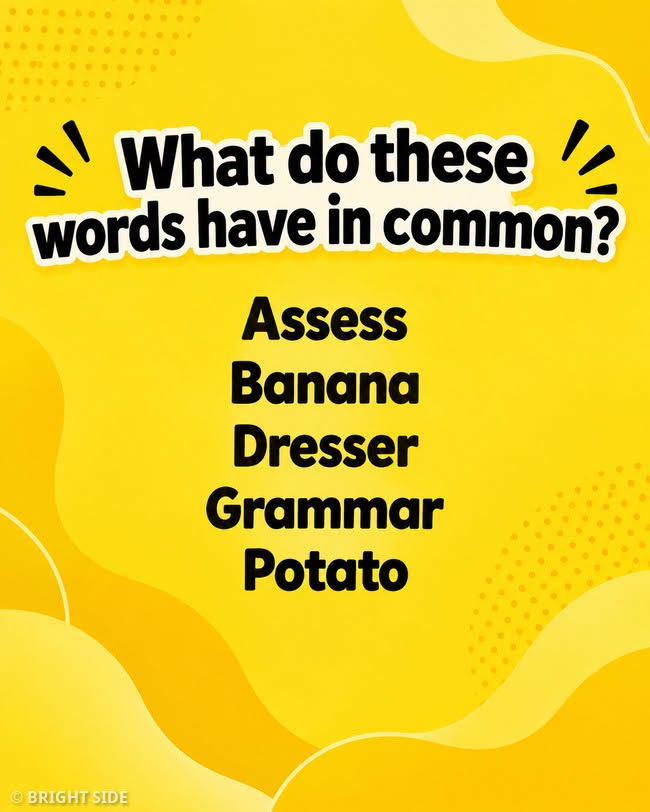
Word riddles and brainteasers are a fantastic way to test your pattern recognition, critical thinking, and linguistic skills. While some word puzzles rely on definitions, synonyms, or rhyming schemes, others challenge you to look at the structural spelling and letter arrangements within the words themselves.The image above asks a classic riddle: “What do these words have in common? Assess, Banana, Dresser, Grammar, Potato.” At first glance, these five words seem completely unrelated in meaning—spanning actions, fruit, furniture, language rules, and vegetables. However, they share a very specific and clever structural trick. In this article, we reveal the answer to the puzzle, explain how it works, and look at how problem-solving skills support everyday decision-making.1. The Hidden Pattern RevealedIf you take the first letter of each word and move it to the very end, and then read the remaining letters backward, you get the exact same word!+—————+———————+———————+———————+
| Original Word | Move First Letter | Read Remaining | Result |
| | to the End | Letters Backward | |
+—————+———————+———————+———————+
| Assess | ssess + A -> ssessa | ssess + A | Assess |
| Banana | anana + B -> ananab | anana + B | Banana |
| Dresser | resser + D -> resserd| resser + D | Dresser |
| Grammar | rammar + G -> rammarg| rammar + G | Grammar |
| Potato | otato + P -> otatop | otato + P | Potato |
+—————+———————+———————+———————+
How the Trick Works Step-by-StepStep 1: Remove the initial starting letter of the word.Step 2: Place that initial letter at the very end of the string.Step 3: Spell the word starting from the second letter through to the end, then append the first letter—reading the sequence yields the original word perfectly intact.Another simpler way to think about it: If you remove the first letter, the rest of the word forms a palindrome!Assess $\rightarrow$ ssess (palindrome)Banana $\rightarrow$ anana (palindrome)Dresser $\rightarrow$ resser (palindrome)Grammar $\rightarrow$ rammar (palindrome)Potato $\rightarrow$ otato (palindrome)2. Why Word Puzzles Are Great for Cognitive HealthEngaging with visual and linguistic riddles regularly offers several mental benefits:Enhances Pattern Recognition: Training your brain to spot non-obvious structural features improves problem-solving agility in daily life.Boosts Working Memory: Keeping track of letter shifts and spelling variations exercises verbal processing skills.Provides Mental Recreation: Quick brainteasers offer a fun, low-stress pause during a busy workday.3. Critical Thinking, Household Organization, and Long-Term SecuritySolving puzzles requires paying close attention to small details—a habit that is just as valuable when organizing household affairs, reviewing contracts, and building financial stability.Protecting Your Household with Strategic PlanningJust as solving a riddle requires looking beyond surface appearances, managing a household demands thorough planning across health, finance, and legal affairs.Securing your family’s baseline begins with comprehensive Health coverage to guarantee uninterrupted access to quality Medical care. Holding structured Insurance policies—such as auto, home, and personal liability coverage—shields your household against unexpected financial shocks.Managing everyday finances thoughtfully creates long-term confidence. Whether securing a home Mortgage, evaluating a personal Loan, or optimizing your household Credit profile, keeping track of fixed expenses maintains solvency. Building a disciplined Investment plan supports major goals like funding higher Education opportunities for children and building a secure Retirement reserve.When establishing a new business venture, expanding a family Business, or drafting major real estate or trust documents, consulting professional Legal Services and working with an experienced Attorney guarantees that every agreement is clear and legally sound.ConclusionThe secret behind “Assess, Banana, Dresser, Grammar, and Potato” is that dropping their first letter reveals a perfect palindrome! Puzzles like this remind us how enjoyable it can be to look at familiar things from a fresh perspective—whether in language games or in everyday planning.Frequently Asked Questions (FAQ)What is a palindrome in linguistics?A palindrome is a word, phrase, number, or sequence of characters that reads the exact same backward as forward (e.g., “radar,” “level,” or “kayak”).Are there other words that follow this exact rule?Yes! Other examples include words like Revive (eviv-e), Uneven (neven-u), and Voodoo (oodoo-v). Removing the first letter leaves a palindrome in each case.How can I get better at solving word riddles?Practice regularly by looking for structural properties rather than just word definitions—check for letter counts, repeated vowels, anagrams, and sub-words hidden inside longer strings.
Word Puzzle Breakdown: What Do These 5 Words Have in Common?