
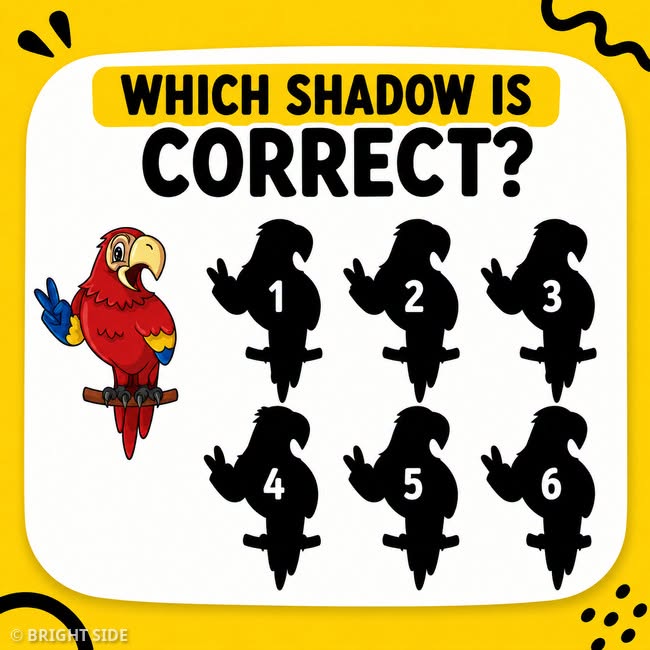
Visual puzzles have taken the internet by storm, offering a quick yet effective way to test our observation skills, attention to detail, and cognitive flexibility. From simple hidden-object challenges to intricate visual illusions, these brain teasers do far more than just pass the time—they actively engage our minds. Among the most popular micro-puzzles circulating on social media are shadow-matching games, where players are tasked with identifying the single exact silhouette that matches a colorful reference image.
While these riddles may appear straightforward at first glance, they rely on complex perceptual mechanisms that require our brain to process shape, proportion, orientation, and subtle contour variations. In this article, we will delve into the science behind visual brain teasers, explore why shadow puzzles are uniquely effective for cognitive exercise, reveal the solution to the parrot shadow puzzle, and examine practical ways to keep your mind sharp every day.
The Science Behind Visual Perception and Shadow Matching
When you look at an image, your brain instantly goes to work converting light and color signals into recognizable objects. Visual discrimination—the ability to recognize details in visual images—is a critical cognitive skill that allows us to spot differences and similarities in shapes, colors, patterns, and forms.
Shadow-matching puzzles specifically target your brain’s ability to process negative space and silhouette outlines. When viewing the original colorful illustration, your brain naturally focuses on color contrast, texture, and internal details like eyes or feathers. However, when examining a silhouette, all internal visual cues are stripped away, forcing your brain to rely purely on spatial geometry and contour analysis.
How Your Brain Solves Visual Puzzles
Solving a visual puzzle involves a sophisticated multi-step neurological process:
-
Feature Extraction: Your visual cortex identifies key landmarks on the main subject—such as the curve of the beak, the spread of the wings, the position of the feet, or the direction of the tail feathers.
-
Mental Isolation: Your cognitive system creates a mental template of the target image while ignoring distracting elements like bright background colors.
-
Comparative Analysis: You systematically scan each silhouette, comparing the mental template against each option to detect minute discrepancies.
-
Pattern Elimination: Options with subtle errors (such as missing claws, altered feather shapes, or inverted poses) are systematically ruled out until only the exact match remains.
Why Daily Brain Games Are Essential for Cognitive Health
Engaging in daily mental stimulation yields long-term benefits for people of all ages. Just as physical exercise strengthens muscle tissue and improves cardiovascular health, mental exercises strengthen neural pathways and enhance neuroplasticity—the brain’s ability to reorganize itself by forming new connections.
Cognitive Benefits of Daily Brain Teasers
-
Improved Focus and Concentration: Completing visual puzzles requires sustained attention. Regular practice helps train your brain to filter out ambient distractions and maintain sharp focus on specific tasks.
-
Enhanced Working Memory: Visual challenges require you to store details of an image short-term while comparing it against multiple variables, strengthening your working memory capacity.
-
Faster Cognitive Processing Speed: The more frequently you challenge your brain with quick visual puzzles, the faster your neural networks process visual stimuli and make logical deductions.
-
Stress Reduction and Mental Mindfulness: Focusing intensely on a fun, low-stakes visual task creates a state of “flow,” helping to calm an overactive mind and reduce daily stress levels.
Step-by-Step Solution: Finding the Correct Parrot Shadow
In the featured visual puzzle, we are presented with a colorful parrot perched on a branch, raising two fingers (or feathers) in a peace sign. To its right are six numbered shadow options (1 through 6). To identify the correct match, we must perform a detailed visual audit of the parrot’s key physical features:
-
The Raised Wing/Hand: The parrot on the left is holding up its blue wing, displaying two distinct raised digits in a “V” or peace gesture.
-
The Beak and Head Contour: Notice the wide, downward-curving upper beak and the open mouth detail underneath.
-
The Perch and Claws: The parrot is sitting on a straight horizontal branch, with three distinct claws gripping the top of the wood.
-
The Tail Feathers: Extending beneath the branch are four long, overlapping tail feathers pointing slightly downward.
Analyzing the Shadow Options
By carefully comparing each silhouette to the original reference image:
-
Shadow 1: Look closely at the raised wing—the fingers or gesture angle are slightly modified or truncated.
-
Shadow 2: Examine the tail feathers beneath the branch—the length and arrangement do not match the original proportion.
-
Shadow 3: Check the beak contour and head curvature—the open beak area presents a subtle discrepancy.
-
Shadow 4: Check the perch and gripping claws—the spacing of the feet on the branch is altered.
-
Shadow 5: Observe the overall silhouette outline—the curvature of the back and the raised wing alignment differ from the original artwork.
-
Shadow 6: The Exact Match! Comparing every single node—from the two raised wing tips to the exact beak profile, three branch-gripping claws, and trailing tail feathers—Shadow 6 mirrors the original illustration perfectly.
The Intersection of Mind Games, Education, and Digital Wellness
In today’s fast-paced digital world, micro-learning and bite-sized mental challenges have become key components of modern lifestyle and education habits. Incorporating quick brain workouts into daily routines offers a quick mental reset during busy workdays.
Practical Tips to Keep Your Mind Sharp
Beyond solving digital puzzles, maintaining long-term brain health and cognitive longevity requires a holistic approach to wellness, education, and lifestyle choices:
-
Prioritize Lifelong Education: Learning new languages, mastering musical instruments, or taking online technology courses keeps neural pathways active and adaptable.
-
Invest in Physical Health: Regular cardiovascular exercise increases blood flow to the brain, supporting the growth of new brain cells and improving overall executive function.
-
Maintain Healthy Nutrition: A diet rich in omega-3 fatty acids, antioxidants, and essential vitamins supports cognitive health and protects against age-related decline.
-
Manage Stress and Rest: Quality sleep is vital for memory consolidation. Ensuring 7–8 hours of restful sleep allows the brain to repair and process daily information efficiently.
-
Explore Professional Healthcare Guidance: If you experience noticeable changes in memory or focus, consulting medical professionals or healthcare specialists can provide personalized strategies for cognitive maintenance.
Interesting Facts About Visual Perception and Human Cognition
-
Instant Visual Processing: The human brain can process full images seen for as little as 13 milliseconds, making visual identification one of our fastest cognitive mechanisms.
-
Negative Space Utilization: Professional graphic designers and artists utilize negative space specifically because the human brain naturally seeks to construct complete shapes from empty outlines.
-
Neuroplasticity Across Life: Cognitive training games can stimulate neuroplasticity regardless of age, proving that adults can continuously build new mental acuity.
-
Pareidolia Effect: Humans frequently see faces or familiar shapes in random patterns or shadows due to our brain’s hyper-tuned visual recognition systems.
Conclusion
Visual puzzles like shadow-matching challenges are far more than simple entertainment—they are engaging, accessible brain exercises that promote visual discrimination, logical reasoning, and sustained focus. By taking a few moments each day to challenge your visual perception, you give your mind a valuable cognitive workout that pays dividends in mental clarity and processing speed.
Whether you enjoy visual riddles, crosswords, logic games, or structural educational challenges, keeping your brain engaged is one of the best investments you can make for long-term cognitive wellness.
Frequently Asked Questions (FAQ)
What is visual discrimination, and why is it important?
Visual discrimination is the ability to perceive subtle differences and similarities in shapes, forms, colors, and patterns. It is an essential skill for reading, spatial awareness, driving, and everyday problem-solving.
How often should I practice brain teasers or visual puzzles?
Engaging in brain puzzles for 5 to 15 minutes daily is ideal. Consistency is key when it comes to keeping neural connections active and improving processing speed over time.
Can brain games help prevent cognitive decline?
While brain games alone are not a guaranteed cure or prevention for neurodegenerative diseases, research shows that active mental engagement, combined with healthy lifestyle choices, builds cognitive reserve and supports brain health as you age.
Why do silhouettes feel harder to match than full-color images?
Color images provide internal contrast cues like eyes, shading, and texture. Silhouettes strip away all internal information, forcing the brain to evaluate pure outline shape and spatial geometry, which engages different cognitive pathways.
