
Visual illusions and spatial puzzles are a popular way to test perception, logical reasoning, and attention to detail. When objects are presented with curves, loops, or squiggles, our brains are easily tricked into assessing length based purely on vertical height rather than actual unraveled distance.
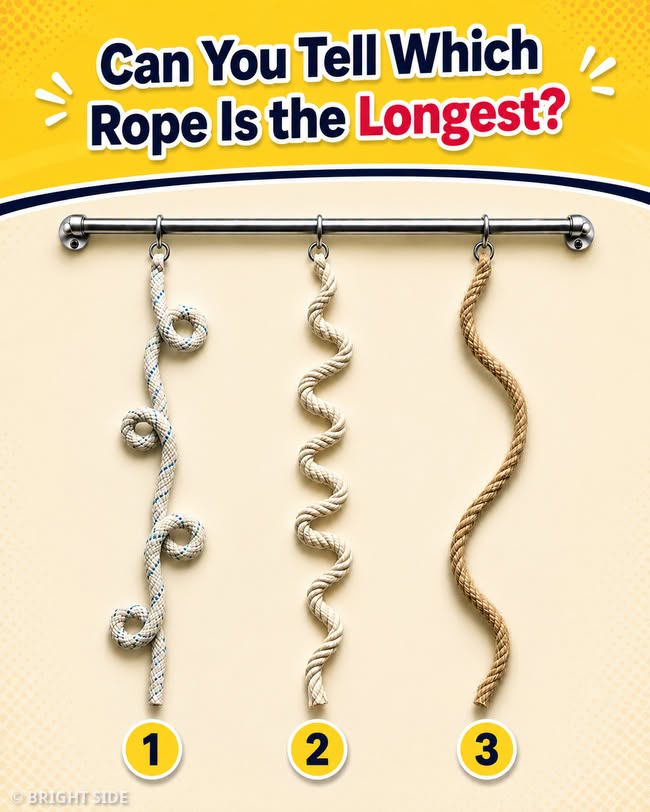
In the puzzle image above, three different ropes hang from a horizontal metal rod, all reaching roughly the same vertical endpoint at the bottom:
-
Rope 1: A patterned climbing-style rope containing four distinct, full loop knots along its length.
-
Rope 2: A light-colored twisted rope featuring tight, repeated wavy squiggles.
-
Rope 3: A natural jute rope with gentle, wide S-curves.
By analyzing the path and hidden length within each shape, we can determine which rope is truly the longest.
Step-by-Step Breakdown
To find the longest rope, we must evaluate how much length is consumed by the bends and loops of each option:
1. Analyzing Rope 3
-
Rope 3 follows soft, wide waves without any tight turns or full overlaps.
-
While longer than a completely straight line of the same vertical span, it uses the least amount of extra slack among the three options.
2. Analyzing Rope 2
-
Rope 2 features tight, dense zig-zags and waves throughout its entire drop.
-
Each crest and trough adds significant hidden length, making it noticeably longer than Rope 3 when straightened out.
3. Analyzing Rope 1
-
Rope 1 drops vertically while taking up massive extra material through four full, looped knots along its stem.
-
Each complete loop wraps around itself, hiding a substantial amount of total rope length within those tight circles while still hanging to the same bottom level as the others.
The Final Answer
Rope 1 is the longest! The four full loops hide the most extra material, meaning that if all three ropes were pulled straight, Rope 1 would stretch out significantly further than Rope 2 or Rope 3.
Why Visual Perception Riddles Trick the Brain
-
Vertical Bias: Human vision tends to estimate the length of hanging objects by their top and bottom endpoints rather than counting every bend and loop.
-
Underestimating Hidden Loops: Complete loops require significantly more material than gentle waves or zig-zags, masking true length.
-
Fun Spatial Exercise: Provides a quick, satisfying mental challenge that sharpens focus and spatial reasoning.
