
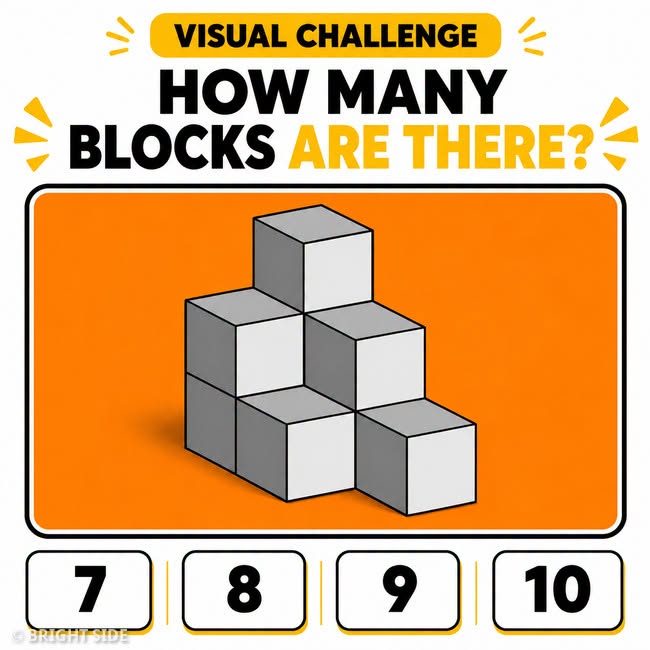
Spatial reasoning puzzles are a fantastic way to test your 3D visualization skills. At first glance, a 2D image of a block stack might seem simple, but counting hidden support blocks requires you to mentalize the structure in three dimensions.
Looking closely at the image above, the key to solving the riddle lies in counting both the visible blocks and the hidden blocks required to keep the upper layers elevated.
Step-by-Step Breakdown
Let’s break the structure down column by column (from back/top to front/bottom) to find the total:
-
Top Level (Height of 3):
-
There is 1 block sitting at the highest point.
-
For this top block to stay supported, there must be 2 hidden blocks directly underneath it in that same column.
-
Column total = 3 blocks.
-
-
Middle Level (Height of 2):
-
To the left of the top column, there is 1 block elevated at the second level. It rests on 1 hidden block beneath it. (Subtotal = 2 blocks)
-
To the right of the top column, there is another 1 block elevated at the second level. It also rests on 1 hidden block beneath it. (Subtotal = 2 blocks)
-
Middle columns total = 4 blocks.
-
-
Bottom Level (Height of 1):
-
In the front layer, there are 2 single blocks resting directly on the ground floor.
-
Front columns total = 2 blocks.
-
The Final Calculation
Adding up the blocks in every column: 3 (back column) + 2 (middle left) + 2 (middle right) + 1 (front center) + 1 (front right) = 9
The correct answer is 9!
Why Spatial Puzzles Are Great for Your Brain
-
Improves 3D Visualization: Exercises your mind’s eye to process depth and hidden structures.
-
Sharpens Problem-Solving: Forces a structured, step-by-step approach rather than a quick guess.
-
Quick Cognitive Exercise: Provides a fast, rewarding mental workout anywhere.
