
FACEBOOK POST:
Think you know basic physics and chemistry? 🧊💧🧂 Drop your answer in the comments! 👇
ARTICLE:
Which Cup Is Heavier? The Physics Riddle That Tests Your Science Knowledge
Riddles involving volume, mass, and density frequently pop up across social media, challenging people to think beyond immediate appearances. While ice cubes might look bulky and a full cup of water seems substantial, comparing these three cups requires looking closely at physical properties and substance density.
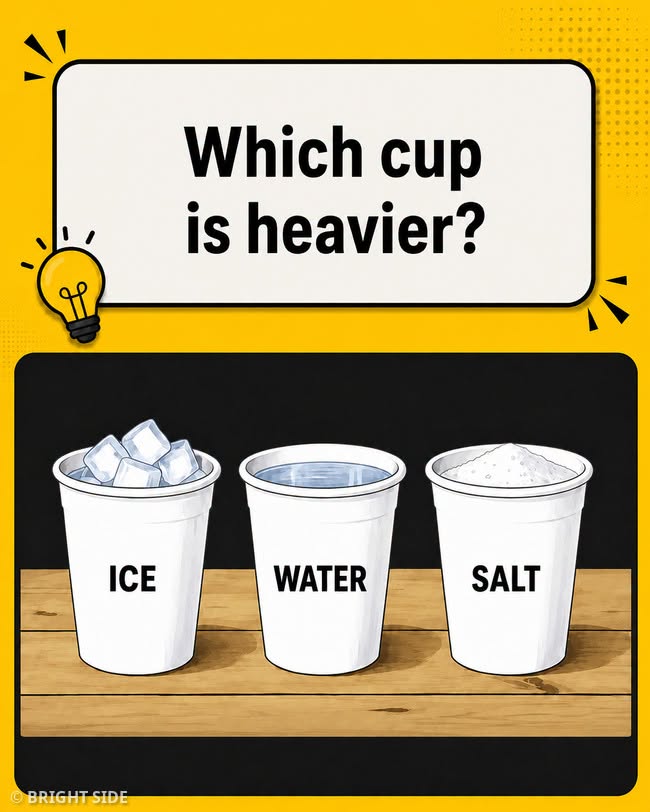
In the puzzle image above, three identical cups are filled to the top with ICE, WATER, and SALT. To determine which cup is the heaviest, we need to analyze the density and structural characteristics of each substance.
Step-by-Step Science Breakdown
Assuming each cup has the exact same volume, the weight of the contents depends directly on the density of each material.
1. Ice vs. Water
-
Density of Liquid Water: approximately 1.0 g/cm³
-
Density of Ice: approximately 0.92 g/cm³
When water freezes into ice, its molecular structure expands, making ice less dense than liquid water. Additionally, solid ice cubes leave empty air spaces (voids) inside the cup. Therefore, a cup filled with ice cubes weighs significantly less than a full cup of liquid water.
2. Water vs. Salt
-
Density of Table Salt (Sodium Chloride):
-
Bulk density of granulated table salt: approximately 1.2 g/cm³ to 1.3 g/cm³
-
Solid density of sodium chloride crystals: approximately 2.16 g/cm³
-
Even accounting for the small air gaps between salt granules, table salt has a much higher bulk density than liquid water.
The Final Answer
Because salt is significantly denser than both water and ice, the cup with SALT is the heaviest!
Why Science Riddles Challenge Us
-
Confusing Volume with Mass: People often mistake visual fill levels for actual mass or weight.
-
Overlooking Air Voids: Puzzles with solid objects (like ice cubes) force us to consider the empty space between the items.
-
Everyday Physics: They serve as a quick reminder of fundamental concepts like density and phase changes.
