
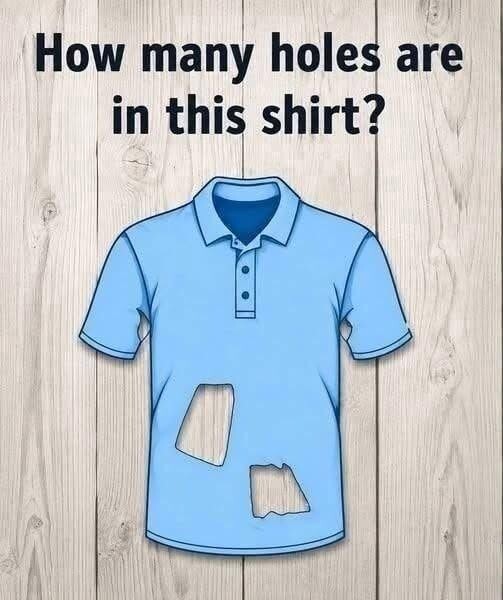
Visual riddles and brain teasers are among the most popular content shared across social media platforms. They challenge our perception, test our attention to detail, and spark lively debates in comment sections. One of the most famous viral puzzles asks a seemingly straightforward question: “How many holes are in this shirt?”
While most viewers instantly point to the prominent ripped holes in the middle of the fabric, the correct answer requires looking beyond the obvious damage and considering the complete anatomy of a shirt. In this complete riddle breakdown, we will count every single hole step-by-step, explain the logic behind the solution, explore why so many people get it wrong, and share the fascinations of visual cognition.
The Complete Breakdown: Counting Every Hole
To find the true total, we need to categorize the openings into two groups: standard anatomical openings built into every shirt and torn holes ripped through the fabric layers.
1. Standard Structural Openings (4 Holes)
Every wearable polo shirt or t-shirt features four fundamental openings that allow a person to wear it:
-
The Neck Hole: The top collar opening where your head goes through.
-
The Bottom Opening: The large main opening at the waist.
-
The Left Sleeve Opening: The armhole for the left arm.
-
The Right Sleeve Opening: The armhole for the right arm.
2. Ripped Holes Through the Fabric (4 Holes)
When looking at the front of the shirt, you can see two large, jagged torn holes in the torso area. However, because you can see the wooden background directly through the shirt, these tears go completely through both the front and back layers of fabric.
+-------------------------------------------------------------------+
|                        RIDDLE LOGIC CHECK                         |
| Because you can see the wooden background straight through the   |
| shirt, both torn spots pass through both the front and back      |
| panels—meaning 2 torn spots = 4 separate fabric holes!            |
+-------------------------------------------------------------------+
-
Front-Left Tear: 1 hole in the front panel + 1 corresponding hole in the back panel = 2 holes
-
Front-Right Tear: 1 hole in the front panel + 1 corresponding hole in the back panel = 2 holes
The Final Count
Adding all structural and ripped openings together gives the total:
| Category | Hole Description | Quantity |
| Standard Openings | Neck, waist, left sleeve, right sleeve | 4 |
| Front Fabric Tears | Two ripped openings in the front panel | 2 |
| Back Fabric Tears | Two corresponding ripped openings in the back panel | 2 |
| TOTAL HOLES | All combined openings | 8 |
There are 8 holes in total!
Why Do So Many People Get It Wrong?
Brain teasers like this rely on cognitive biases and selective attention. Here is why the majority of people guess incorrectly:
-
Guessing 2: People focus exclusively on the visible damage on the front surface without considering the standard shirt openings or the back layer.
-
Guessing 4: People count the 2 torn spots on the front plus the 2 visible torn spots on the back, but forget to count the neck, waist, and sleeve openings.
-
Guessing 6: People count the 4 standard shirt openings (neck, waist, 2 sleeves) plus the 2 visible front torn spots, failing to realize the tear passes through the back of the shirt as well.
By tricking your brain into focusing only on the obvious tears, the riddle exploits an effect known as inattentional blindness—where you overlook obvious features right in front of you because your focus is directed elsewhere.
Financial, Mental, and Cognitive Benefits of Brain Teasers
Engaging in regular mental exercises and logic puzzles offers valuable cognitive and lifestyle advantages:
-
Cognitive Flexibility & Brain Health: Solving riddles stimulates problem-solving neural pathways, supporting mental acuity, critical thinking skills, and long-term cognitive health. Maintaining sharp problem-solving habits supports overall mental wellness, helping lower personal health and medical risks associated with cognitive decline.
-
Patience & Attention to Detail: Visual puzzles teach us to slow down, analyze evidence thoroughly, and avoid impulsive decisions. This habit translates directly into smart daily financial habits—such as auditing contracts, managing budgets, and planning investment, retirement, or education savings without overlooking critical details.
-
Social Engagement: Sharing engaging puzzles creates fun, stress-free interactions across personal networks and community groups.
Fascinating Facts About Textiles and Puzzles
-
Topological Definition of a Hole: In mathematics and topology, a doughnut or a shirt sleeve is classified as a surface with a continuous through-hole. By mathematical definition, every standard t-shirt is a topological object with multiple pass-through channels!
-
The Origin of the Polo Shirt: The polo shirt was popularized by French tennis legend René Lacoste in the 1920s, designed with a flexible soft collar and short sleeves to replace stiff, uncomfortable long-sleeve tennis attire.
-
Cognitive Priming: Brain teasers use “priming” in their text (such as stating “Only 1 in 7 get it right”) to heighten alertness, making your brain overthink simple details or rush into hasty assumptions.
Conclusion
While it is easy to glance at the image and quickly guess two or four, a closer inspection reveals the true answer: 8 holes. By accounting for the neck, waist, two sleeves, and the two double-sided torn holes passing through both fabric panels, you can proudly join the small percentage of people who solve this viral brain teaser correctly!
Frequently Asked Questions (FAQ)
What is the correct answer to the shirt hole riddle?
The correct answer is 8 holes. This includes 4 standard structural openings (neck, waist, left sleeve, right sleeve) and 4 torn holes (2 in the front panel and 2 corresponding holes in the back panel).
Why do the torn spots count as 4 holes instead of 2?
Because you can see the wooden background directly through the torn areas, the tears go completely through both the front layer and the back layer of the shirt. Two see-through tears through two layers of fabric equal 4 individual holes in the cloth.
What if the back of the shirt doesn’t have holes?
If the back of the shirt were solid blue, you would see the blue inner back fabric through the front tears instead of the light wooden background. The visible wood pattern proves that the tears pass entirely through both sides of the shirt.
Does the button placket or collar count as extra holes?
In standard versions of this graphic riddle, small buttonholes or collar seams are ignored, focusing strictly on the main body openings and the see-through fabric tears.
