
Visual challenges and counting puzzles have captured the fascination of millions on social media, sparking debate and encouraging sharp-eyed internet users to test their observational skills. From hidden-object illustrations to clever overlapping image puzzles, these viral brain teasers serve as more than just lighthearted entertainment—they act as quick, stimulating mental workouts that reveal fascinating insights into human visual perception and focus.
Among the most captivating types of visual riddles are multi-layered counting puzzles featuring nested images. On the surface, counting a cluster of orange tabby cats seems simple enough. However, when smaller kittens are subtly layered into ears, paws, and background shadows, the puzzle transforms into a complex test of attention to detail. In this comprehensive guide, we will analyze the visual neuroscience behind counting illusions, break down the step-by-step solution to the orange cat counting puzzle, and explore how daily mental exercises contribute to long-term brain health and cognitive flexibility.
How the Human Brain Processes Complex Visual Scenery
When you look at a busy image, your eyes do not simply capture a single static photograph. Instead, your eyes perform rapid, involuntary movements called saccades, scanning different focal points across the image multiple times per second. The visual cortex in your brain then stitches these micro-scans together to construct a coherent mental picture.
In puzzles featuring repeating elements—such as a cluster of similar ginger cats—the brain often relies on a cognitive shortcut known as pattern recognition. While pattern recognition allows us to identify objects instantly, it can also cause us to overlook tiny details that blend seamlessly into larger structures.
Key Visual Mechanisms at Play
-
Selective Attention: Your brain prioritizes prominent, large objects (like the major cats forming the main pile) while temporarily filtering out tiny, secondary details (such as micro-kittens tucked near the ears or paws).
-
Figure-Ground Perception: This cognitive ability allows us to distinguish an object (the figure) from its background (the ground). In nested visual puzzles, smaller elements act as both figure and background simultaneously, tricking the eye.
-
Gestalt Grouping Principles: The brain naturally groups items of similar color, texture, and shape together. Because all the cats in the illustration share identical orange tabby fur and golden eyes, distinguishing individual boundaries requires deliberate visual concentration.
Detailed Breakdown: How Many Cats Are in the Image?
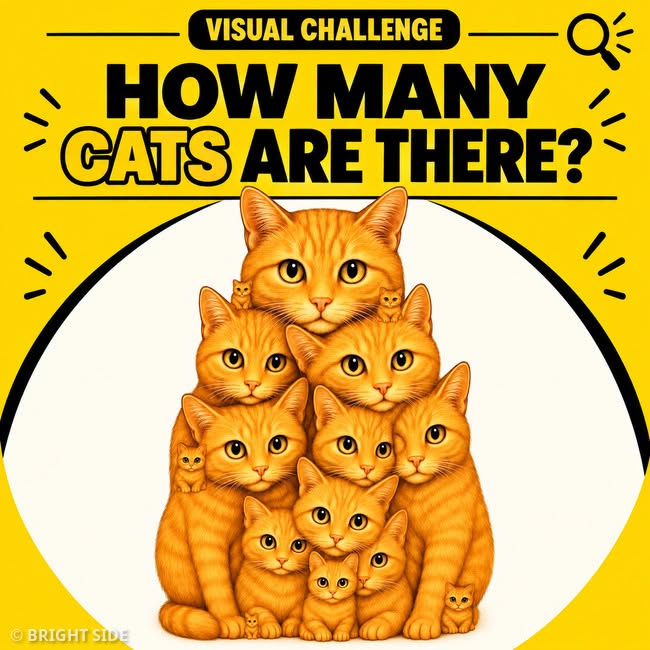
To find the correct total in this viral visual challenge, we must systematically scan the image from top to bottom, layer by layer, making sure to spot both the prominent cats and the tiny hidden kittens.
Let us break down the exact count across the entire pyramid structure:
1. The Top Layer
-
1 Large Top Cat: The dominant cat sitting at the peak of the stack.
-
2 Micro Kittens: Look closely at the shoulders/ears of the top cat—there is one tiny kitten perched on the left shoulder and another tiny kitten perched on the right shoulder.
2. The Upper-Middle Layer
-
1 Medium Cat (Left): Directly below the left side of the top cat’s chin.
-
1 Medium Cat (Right): Directly below the right side of the top cat’s chin.
3. The Central & Mid-Lower Layer
-
1 Prominent Mid-Left Cat: Sitting lower on the left side, looking forward.
-
1 Micro-Kitten (Far Left): Perched on the outer arm/body of the mid-left cat.
-
1 Mid-Right Cat: Tucked into the center-right area with a soft expression.
-
1 Large Right-Side Cat: Standing tall on the far right edge of the cluster.
4. The Bottom Foundation Layer
-
1 Lower-Center Cat: Positioned right in the middle below the central faces.
-
1 Bottom-Left Kitten: Sitting at the front-left base.
-
1 Micro-Mini Kitten: Sitting at the very bottom between the paws on the left.
-
1 Tiny Front-Center Kitten: Sitting right at the bottom middle.
-
1 Bottom-Right Kitten: Sitting near the front-right base.
-
1 Micro-Kitten (Far Bottom Right): Tucked against the paw of the large right-side cat.
The Final Count
By conducting a meticulous top-to-bottom audit that includes every major cat, medium-sized feline, and micro-kitten nestled into the fur, the complete visual total comes to 15 cats in total.
Why Daily Brain Teasers Support Mental Longevity and Focus
Consistently challenging your brain with visual discrimination games, crosswords, logic puzzles, and memory tasks helps foster cognitive reserve—the brain’s resilience and ability to improvise, find alternate neural pathways, and manage daily challenges effectively.
Health and Lifestyle Benefits of Mental Games
-
Sharper Visual-Spatial Awareness: Regularly scanning detailed images enhances your spatial intelligence, helping with real-world tasks like driving, navigation, and detailed reading.
-
Enhanced Working Memory: Keeping track of items you have already counted forces your short-term memory to process and hold dynamic information active.
-
Mindful Stress Relief: Engaging deeply with an entertaining riddle offers a meditative break from work, reducing daily anxiety and promoting restful focus.
-
Inspiration for Lifelong Education: Engaging with cognitive games encourages a broader interest in lifelong learning, health, science, and personal development.
Integrating Brain Training into Modern Wellness Routines
Just as maintaining physical health through exercise, balanced nutrition, and preventive medical care is crucial, prioritizing mental fitness is essential for holistic wellness. Incorporating cognitive workouts into your daily routine is simple and highly rewarding.
Practical Tips for Keeping Your Mind Sharp
-
Schedule Daily Mental Workouts: Dedicate 10 minutes every morning or evening to solving visual riddles, Sudoku, or word puzzles.
-
Explore New Educational Hobbies: Take up new technical skills, learn a foreign language, or study music to keep your brain forming new neural connections.
-
Support Brain Health with Nutrition: Fuel your mind with nutrient-rich foods packed with antioxidants, healthy fats, and vitamins, while staying well-hydrated throughout the day.
-
Protect Your Vision: Regular eye exams with healthcare professionals ensure your eyesight remains sharp, making visual processing effortless and strain-free.
-
Manage Stress and Prioritize Rest: High-quality sleep allows your brain to consolidate memories, repair cellular structure, and prepare for peak mental performance each day.
Fun Facts About Feline Perception and Visual Illusions
-
Superior Visual Field: While humans have a visual field of approximately 180 degrees, cats possess a 200-degree field of view, giving them exceptional peripheral awareness.
-
Motion Detection: Cats are far better at detecting subtle movements in low light than humans, thanks to a higher concentration of rod receptors in their retinas.
-
The Power of Saccadic Eye Movements: Human eyes make over 100,000 saccadic movements per day, constantly feeding tiny snapshots of detail to the brain’s visual processing center.
-
Neuroplasticity in Action: Studies show that adults who participate in visual search tasks over extended periods demonstrate measurable speed improvements in target identification.
Conclusion
Visual challenges like the orange cat counting puzzle offer an ideal blend of entertainment and cognitive exercise. They push us to slow down, bypass superficial visual shortcuts, and engage in disciplined, detail-oriented observation. By taking a few moments each day to solve fun visual puzzles, you give your brain a rewarding workout that enhances focus, strengthens memory, and sharpens visual perception.
Frequently Asked Questions (FAQ)
Why are visual counting puzzles so surprisingly difficult?
These puzzles rely on repeating patterns, consistent colors, and layered sizing. Because human visual processing relies heavily on pattern recognition, our brains naturally group similar objects together, causing us to overlook smaller items nestled inside larger shapes.
How can I improve my speed and accuracy at visual puzzles?
Adopt a systematic scanning strategy. Instead of looking randomly across the image, scan strictly in grid sections—such as top-to-bottom or left-to-right—and count items by category or size layer.
Do brain puzzles really help improve everyday concentration?
Yes! Engaging in tasks that require sustained, selective attention helps train the prefrontal cortex to resist ambient distractions, leading to better focus during daily work or study activities.
What should I do if I keep getting different answers on counting games?
Try using a physical or digital pointer to trace each object as you count it, or break the image down into distinct quadrants. Marking off items systematically prevents double-counting and eliminates blind spots.
