
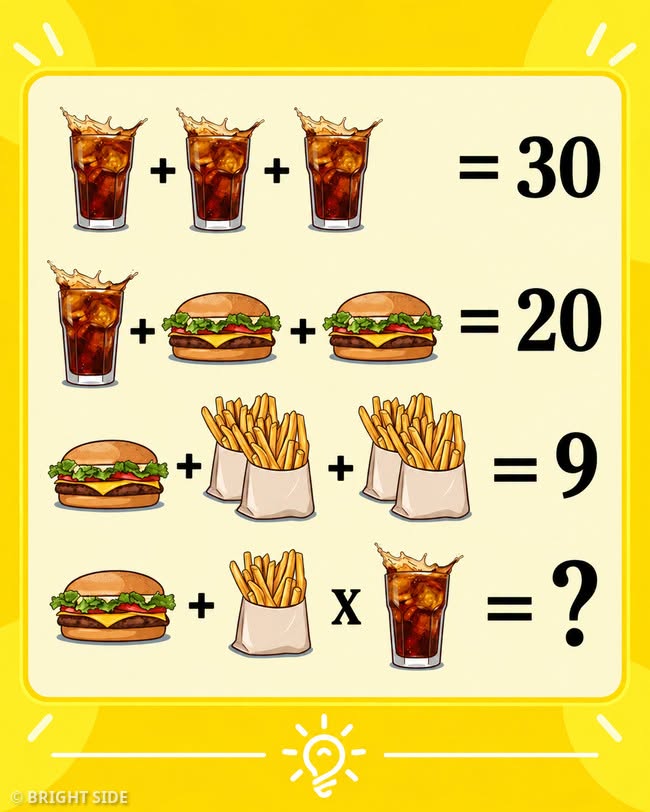
Math puzzles featuring pictures of fast food, fruits, or everyday items frequently take social media by storm, generating thousands of comments and debates. On the surface, these visual equations appear to be simple primary school arithmetic. However, they are specifically designed to trip up casual readers using subtle visual variations and fundamental rules of mathematics that many people forget over time.
These brain teasers serve as more than just entertaining scroll-stoppers—they are excellent micro-exercises for critical thinking, visual attention to detail, and algebraic reasoning. In this comprehensive guide, we will break down the mathematical principles behind picture equations, perform a step-by-step mathematical proof to find the true final value of this viral puzzle, and explore how daily logic challenges keep your mind sharp and active.
The Mathematical Principles Behind Visual Equations
Picture puzzles substitute traditional algebraic variables like $x$, $y$, and $z$ with recognizable symbols such as soda cups, burgers, and french fries. To solve them accurately, two distinct cognitive skills are required: precise visual observation and strict adherence to the order of operations.
1. Symbol Identification and Variable Isolation
Before performing any calculation, every visual element must be evaluated carefully. Puzzle creators love to introduce subtle tricks:
-
Quantity Changes: A picture in an early line might represent a pair or set of items, while the final line features a single item.
-
Operator Swaps: Addition signs ($+$) are frequently used in the setup lines, while the final question line unexpectedly introduces multiplication ($\times$) or subtraction ($-$).
-
Order of Operations: The standard mathematical convention dictates that multiplication and division must always take precedence over addition and subtraction, unless parentheses dictate otherwise.
Step-by-Step Solution: Solving the Fast Food Math Puzzle
To determine the correct final answer, let us break down each equation line by line, defining the exact numerical value of each item represented in the puzzle.
Equation 1: Finding the Value of the Drink
The first equation consists of three identical soda cups added together:
Solving for a single drink:
Thus, 1 Soda Drink = 10.
Equation 2: Finding the Value of the Burger
The second equation features one soda drink plus two identical burgers:
Substituting the value of the drink ($10$) into the equation:
Thus, 1 Burger = 5.
Equation 3: Finding the Value of the French Fries
The third equation shows one burger plus two packs of french fries. Look closely at the image: each of those two packs is actually a double pack containing two bags of fries placed together!
Substituting the value of the burger ($5$):
Since two bags of fries equal $2$, a single bag of french fries = 1.
Equation 4: Solving the Final Question
Now we analyze the final expression:
Notice two vital details in this final line:
-
There is only one single bag of fries (worth $1$), not a double pack!
-
The operational sign between the fries and the drink is a multiplication sign ($\times$), not an addition sign!
Plugging in our known values:
Applying PEMDAS / BODMAS Rules
Mathematical order of operations dictates that multiplication must be performed before addition:
-
Multiplication First: $1 \times 10 = 10$
-
Addition Second: $5 + 10 = 15$
The final correct answer is 15.
Why Common Misconceptions Lead to Wrong Answers
When people answer this viral riddle on social media, they frequently land on incorrect numbers like $25$ or $60$. Here is why those mistakes happen:
-
The “Left to Right” Error (Getting 60): If someone ignores the order of operations and adds $5 + 1$ first to get $6$, then multiplies by $10$, they end up with $60$.
-
The Double-Fries Oversight (Getting 25): If someone fails to notice that the fries in line 3 were double bags while line 4 shows a single bag, they might assume fries are worth $2$. Calculating $5 + (2 \times 10)$ gives $25$.
Paying close attention to visual details and mathematical sequence prevents these classic traps.
Cognitive and Lifestyle Benefits of Math Challenges
Regularly challenging yourself with math problems, visual riddles, and logic puzzles provides measurable cognitive benefits that positively impact daily decision-making, professional performance, and lifelong learning.
Key Benefits of Problem-Solving Exercises
-
Sharper Critical Thinking: Logic puzzles train the brain to break complex problems into smaller, manageable components before jumping to quick conclusions.
-
Improved Attention to Detail: Spotting tiny variations in picture puzzles strengthens working visual memory and observational precision.
-
Enhanced Financial Literacy: Practicing basic mental math and algebraic relationships reinforces numerical fluency, which aids in everyday budgeting, investment planning, and personal finance management.
-
Stress Reduction and Mindfulness: Focusing intently on a clear, logical problem provides a healthy distraction from daily work fatigue, promoting mental clarity.
Everyday Strategies to Keep Your Brain Active
Beyond online visual challenges, prioritizing mental workouts and healthy lifestyle choices ensures optimal cognitive longevity and focus.
-
Practice Mental Math Daily: Calculate tips, discounts, or grocery totals in your head before checking a calculator.
-
Explore New Technical Hobbies: Learning computer programming, playing a strategic musical instrument, or taking online technology and finance courses keeps neural connections flexible.
-
Prioritize Comprehensive Physical Health: Quality cardiovascular exercise improves oxygen delivery to the brain, while sound sleep allows the brain to consolidate memory.
-
Consult Healthcare and Medical Professionals: Regular health checkups help identify and manage conditions that affect mental sharpness and energy levels as you age.
Interesting Facts About Math and Human Perception
-
Origins of PEMDAS: The standard order of operations rules were formalized in late 19th and early 20th-century algebra textbooks to ensure uniform interpretation of mathematical formulas worldwide.
-
Optical Speed: Human visual processing can detect changes in familiar images in fractions of a second, but higher-order reasoning in the prefrontal cortex is required to notice contextual details like single versus double objects.
-
Neuroplasticity Across Ages: Adults who regularly engage in numeric and logic puzzles maintain higher levels of executive cognitive function compared to those who do not.
Conclusion
Visual math puzzles are a brilliant blend of visual observation and fundamental algebra. By forcing us to slow down, examine fine details, and apply proper order of operations, these challenges provide an enjoyable, rapid brain workout. Next time you encounter a visual riddle online, remember to check for hidden quantities, watch the signs carefully, and apply multiplication before addition!
Frequently Asked Questions (FAQ)
What does PEMDAS stand for, and why is it important?
PEMDAS stands for Parentheses, Exponents, Multiplication and Division (from left to right), and Addition and Subtraction (from left to right). It establishes a universal rule set so that everyone calculates mathematical expressions in the exact same sequence.
Why do people get different answers on picture puzzles?
Most incorrect answers stem from missing subtle visual details—such as a changed quantity of an item—or evaluating operations strictly from left to right instead of following standard mathematical rules.
Can practicing logic games help with real-life problem solving?
Yes! Engaging in structured logic puzzles enhances analytical thinking, pattern recognition, and systematic deduction, which are essential skills in finance, business, engineering, and daily planning.
