
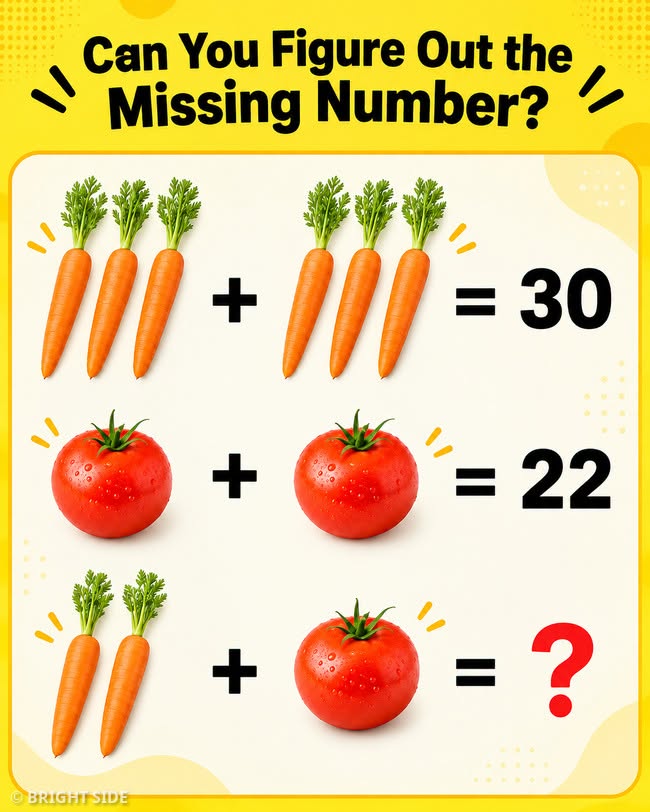
Visual math puzzles and picture-based equations have become a cornerstone of digital entertainment, engaging millions of social media users daily. On the surface, these colorful riddles—featuring items like carrots, tomatoes, fruits, or coffee cups—look like elementary school arithmetic. However, they are intentionally designed to challenge our observational precision, working memory, and deductive logic.
While solving a quick picture puzzle might feel like a casual brain break during a busy day, engaging with these micro-challenges provides genuine cognitive benefits. In this comprehensive guide, we will break down the mathematical logic behind picture equations, perform a step-by-step algebraic solution to find the correct answer to the carrot and tomato puzzle, and explore how daily problem-solving supports focus, education, and cognitive longevity.
The Cognitive Science Behind Visual Equations
Unlike traditional algebraic equations written with standard variables like $x$ and $y$, visual riddles require the brain to process symbolic representations first. To reach the correct solution, your visual cortex and prefrontal cortex must work in tandem to perform two distinct tasks: visual audit and mathematical deduction.
1. Visual Auditing and Counting
Before writing down numbers, you must carefully inspect each visual asset. Puzzle designers frequently rely on subtle visual shifts to test your attention to detail:
-
Groupings vs. Individual Units: A line might display a cluster or bundle of items, while subsequent lines feature fewer individual units.
-
Leaf/Stem Variations: Tiny visual cues, such as the number of green leaves or stems on a vegetable, can represent different underlying numeric values.
-
Symbol Transitions: Addition signs ($+$) may dominate the setup rows, but multiplication ($\times$) or subtraction ($-$) signs might be subtly introduced in the final equation.
2. Variable Isolation and Algebra
Once the visual quantities are established, your brain converts the picture cues into a system of linear equations. Applying elementary algebra allows you to determine the exact value of a single unit before solving the final expression.
Step-by-Step Solution: Solving the Carrot and Tomato Puzzle
To find the missing number in this viral challenge, let us systematically evaluate each row from top to bottom.
Equation 1: Determining the Value of a Single Carrot
The first row presents two groups of carrots added together:
Combining like terms:
Because a group of 3 carrots equals $15$, we divide by 3 to find the value of an individual carrot:
Thus, 1 Carrot = 5.
Equation 2: Determining the Value of a Tomato
The second row presents two identical tomatoes added together:
Combining like terms:
Thus, 1 Tomato = 11.
Equation 3: Solving the Final Line
Now we examine the final question line carefully:
Notice the vital visual detail:
-
The first term consists of 2 carrots, not 3!
-
Since 1 single carrot equals $5$, a group of 2 carrots is worth $2 \times 5 = 10$.
Plugging our known values into the equation:
Solving the expression:
The final correct answer is 21.
Why Most People Get This Puzzle Wrong
When users post their answers in comment sections, the two most common incorrect responses are $26$ and $41$. Understanding where these mistakes occur highlights key aspects of cognitive processing:
-
The Bundle Oversight (Getting 26): Many readers quickly assume that the carrots in the third row carry the same value ($15$) as the groups in the top row. Calculating $15 + 11$ leads directly to $26$.
-
The “Group of Three” Miscalculation (Getting 41): If someone forgets to divide the first row by 3, they might assume a single carrot is worth $15$. Calculating $(2 \times 15) + 11$ gives $41$.
Slowing down to perform a meticulous visual audit prevents these fast-thinking errors.
The Long-Term Benefits of Daily Brain Exercises
Consistently challenging your mind with logic games, numerical riddles, and visual puzzles actively supports cognitive health and mental flexibility across all stages of life.
Key Benefits for Focus and Productivity
-
Enhanced Working Memory: Keeping track of dynamic variables (such as unit values versus grouped values) exercises working memory, which is essential for complex decision-making in daily life.
-
Sharper Detail Orientation: Developing the habit of double-checking visual details transfers directly to professional environments—improving precision in contract review, data entry, and project management.
-
Strengthened Problem-Solving Mindset: Methodical deduction trains the brain to approach multi-step problems systematically rather than jumping to unverified conclusions.
-
Mindful Mental Reset: Brief, structured puzzle breaks offer a healthy alternative to passive scrolling, giving your brain a satisfying dopamine boost while keeping focus sharp.
Integrating Cognitive Fitness into Modern Lifestyle and Wellness
Just as physical exercise, balanced nutrition, and preventive medical care form the foundation of physical health, daily mental workouts contribute to long-term cognitive longevity. Integrating brain-training activities into your daily routine is easy and highly rewarding.
Practical Tips for Keeping Your Mind Active
-
Schedule Daily Micro-Workouts: Dedicate 5 to 10 minutes each day to solving logic games, Sudoku, crosswords, or visual math riddles.
-
Practice Mental Arithmetic: Perform everyday calculations—such as estimating grocery totals, splitting dining bills, or calculating discounts—in your head before reaching for a calculator.
-
Invest in Lifelong Education: Pursue structured online courses in fields like technology, finance, business management, or personal investment to continuously build new neural pathways.
-
Maintain Overall Physical Health: Prioritize quality sleep, regular cardiovascular exercise, and proper hydration to support optimal blood flow and brain function.
-
Consult Healthcare Professionals: Routine checkups with healthcare and medical specialists help manage underlying health conditions that influence energy, focus, and memory as you age.
Fascinating Facts About Human Perception and Math
-
Subitizing Capacity: The human brain can instantly recognize quantities up to 4 without active counting—a cognitive phenomenon known as subitizing. Higher quantities require rapid active counting.
-
Visual Processing Speed: Visual inputs can be identified in under 100 milliseconds, but evaluating logical relationships and arithmetic operations requires sequential processing in the prefrontal cortex.
-
Neuroplasticity in Adulthood: Research demonstrates that adults who regularly participate in problem-solving activities retain higher levels of mental agility and executive cognitive function over time.
Conclusion
Visual math equations like the carrot and tomato riddle offer the perfect balance of lighthearted entertainment and rigorous cognitive exercise. By encouraging us to pause, audit visual details carefully, and apply step-by-step logic, these challenges keep our minds engaged and observant. The next time you see a picture riddle online, take a closer look at the details—you might just spot the hidden trick!
Frequently Asked Questions (FAQ)
What is the trick to solving picture math puzzles correctly?
Always start by determining the value of an individual single item rather than assuming entire groups retain fixed numbers. Pay close attention to subtle variations in quantity, background symbols, and operational signs ($+$, $-$, $\times$).
Why do picture puzzles go viral so easily on social media?
Visual puzzles tap into friendly competition and curiosity. Because different visual interpretations lead to varying answers, they naturally spark high engagement, lively debate, and comment sharing across social networks.
Do visual math games really help with cognitive longevity?
Yes! Engaging in problem-solving activities stimulates neuroplasticity and helps build cognitive reserve, supporting memory, attention span, and processing speed as you age.
