
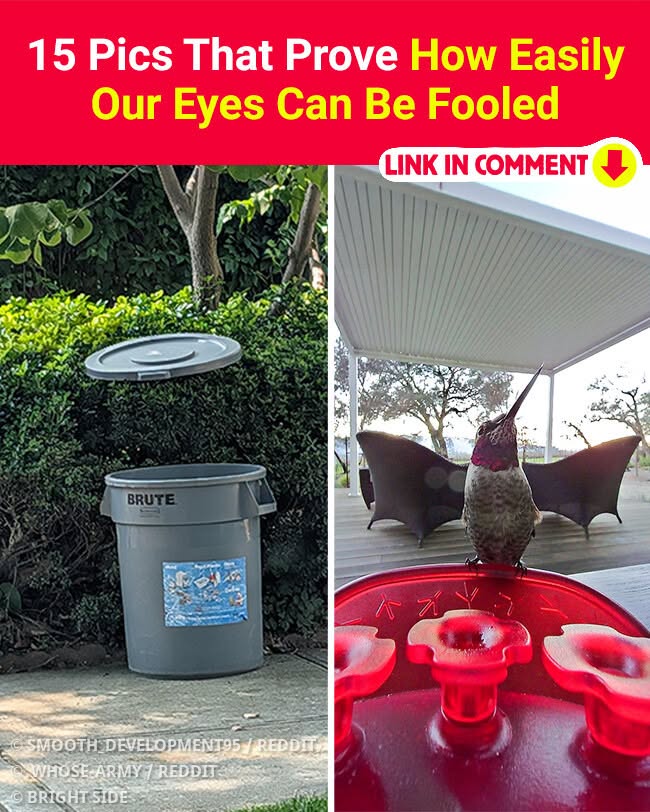
Our eyes are remarkable organs, capable of transmitting complex visual data to the brain in milliseconds. However, despite centuries of evolutionary perfection, human vision is far from foolproof. In fact, our brains are constantly making split-second assumptions, filling in blind spots, and constructing forced perspectives based on shadows, angles, and lighting. When real-world elements align in unexpected ways, the resulting photos can completely trick our perception, making solid trash cans appear to float in mid-air or transforming small birds into giant creatures.
Visual illusions captured in everyday photography—often referred to as accidental optical illusions—have become a massive phenomenon across digital media. These images provide a fascinating look into cognitive psychology, visual processing, and optical mechanics. In this article, we will examine the science behind visual trickery, analyze how floating shadows and perspective shifts confuse the human visual cortex, and explore practical ways to keep your mind engaged through sensory understanding.
The Psychology and Neuroscience of Visual Illusions
To understand why photos can fool our eyes, we must first look at how the human visual system interprets 3D environments from 2D images. When light hits the retina, it captures a flat, two-dimensional projection of the surrounding world. The visual cortex in the brain must then calculate depth, texture, distance, and shape to build a three-dimensional model in our consciousness.
To accomplish this rapidly, the brain relies on cognitive heuristics—mental shortcuts developed through daily experience. When a photograph presents conflicting cues, these heuristics lead to perceptual misinterpretations.
Key Optical Cues that Fool the Mind
-
Shadow Misplacement: Shadows serve as primary depth indicators. When a dark stain or patch on the ground appears directly beneath an object, the brain automatically interprets it as a cast shadow, making the object look as though it is levitating.
-
Forced Perspective: Objects placed closer to a camera lens appear significantly larger than distant background objects. When background contours align seamlessly with foreground items, the brain merges them into a single, oversized entity.
-
Contour and Pattern Matching: The visual system continuously attempts to organize shapes into familiar patterns. Sudden breaks in lighting or background textures can make solid objects appear transparent or disconnected.
Case Studies: Analyzing the Mind-Bending Photography
The featured image showcases two incredible examples of everyday photography that challenge our visual expectation versus reality.
1. The “Floating” Trash Can Illusion
In the left image, a standard plastic trash can appears to be floating several inches above the concrete pavement, with its lid hovering in mid-air above it.
-
The Reality: The illusion is created entirely by a dark, wet patch or stain on the sidewalk positioned right beside the container.
-
The Cognitive Mechanism: Because our brain is hardwired to assume sunlight creates grounded shadows directly beneath objects, it interprets the dark moisture patch as a cast shadow. This causes our visual cortex to perceive the trash can as floating in space, while the angle of the hedge background further obscures the true ground line.
2. The “Giant” Bird under the Patio
In the right panel, a hummingbird sitting on a feeder appears massive, standing as tall as the patio furniture in the background.
-
The Reality: This is a classic example of forced perspective. The bird feeder is positioned just inches away from the camera lens, while the outdoor patio chairs are located many feet away in the yard.
-
The Cognitive Mechanism: Because the roof of the patio extends over both the foreground feeder and the background seating, the brain attempts to evaluate both items within the same spatial plane. Without an explicit depth boundary, the bird looks towering and gargantuan compared to the lounge chairs.
Why Cognitive Traps and Visual Puzzles Fascinate Us
Humans are naturally curious creatures. When presented with an optical paradox, our brains experience a mild form of cognitive dissonance—a gap between what we know to be logically true and what our eyes are actively reporting. Resolving this dissonance by identifying the trick triggers a pleasing release of dopamine, making visual puzzles both addicting and mentally satisfying.
The Educational and Brain-Training Value
-
Strengthening Critical Thinking: Analyzing optical illusions encourages people to look past initial impressions and examine structural details critically.
-
Enhancing Spatial Awareness: Deconstructing forced perspective photos improves visual-spatial processing and geometry comprehension.
-
Encouraging Scientific Literacy: Learning how light, shadows, and optics work fosters a broader interest in physics, neuroscience, and digital photography technology.
Practical Ways to Sharpen Observation Skills and Brain Health
Maintaining active observational skills and mental flexibility is vital at every stage of life. Just as physical fitness requires routine activity, keeping your visual processing and cognitive capabilities sharp involves regular mental workouts and healthy daily habits.
Daily Habits for Cognitive Fitness
-
Engage with Visual and Logic Challenges: Dedicate a few minutes daily to visual search puzzles, optical riddles, or logic games to challenge your brain’s pattern recognition.
-
Explore Creative Arts and Photography: Practicing photography or drawing helps you understand how light, shadows, focal lengths, and angles interact to create realistic or distorted depth.
-
Pursue Lifelong Education: Continuous learning—whether through online courses, technology studies, or financial literacy programs—promotes neuroplasticity and neural adaptability.
-
Prioritize Comprehensive Health and Wellness: Physical health directly impacts cognitive sharpness. A balanced diet rich in essential nutrients, consistent sleep, and regular exercise support brain function and visual health.
-
Consult Healthcare Professionals: Routine eye exams with medical specialists ensure your physical vision remains sharp, allowing your brain to process clear visual inputs without unnecessary strain.
Fascinating Facts About Human Perception and Optics
-
The Blind Spot Hack: Every human eye has a physical blind spot where the optic nerve connects to the retina. The brain automatically “paints in” this missing area using surrounding visual patterns without us ever noticing.
-
Processing Speed: The human brain can interpret full images seen for a fraction of a second, but determining depth and context requires complex micro-calculations across multiple brain regions.
-
Shadow Dominance: Studies show that cast shadows override texture and color cues when the brain determines whether an object is touching a surface or hovering above it.
-
The Moon Illusion: The moon appears substantially larger near the horizon than high in the sky, purely due to forced perspective visual cues provided by buildings and trees on the horizon line.
Conclusion
Everyday optical illusions demonstrate the marvelous complexity of human vision and cognitive processing. Photos like floating trash cans and giant birds remind us that our perception of reality is a carefully constructed interpretation built by the brain. By learning the mechanics behind light, shadows, and perspective, we gain a deeper appreciation for visual science while keeping our minds curious, observant, and sharp.
Frequently Asked Questions (FAQ)
What causes forced perspective in photography?
Forced perspective occurs when a photographer uses the relative distance between foreground and background objects, combined with camera depth-of-field, to make items appear larger, smaller, closer, or farther away than they actually are.
Why do shadows have such a strong effect on depth perception?
Shadows provide critical context regarding light sources and ground contact. Because light naturally travels in straight lines, the brain uses shadow position as an anchor to determine an object’s precise distance from surrounding surfaces.
Can optical illusions help improve brain function?
Engaging with visual riddles and optical challenges stimulates visual discrimination and problem-solving pathways in the brain. While not a standalone solution for brain health, they serve as fun, effective exercises for maintaining focus and attention to detail.
Why do different people see optical illusions differently?
Individual perception can vary based on lighting conditions, display resolution, visual acuity, and prior cognitive associations. The brain relies on personal past experience to interpret ambiguous visual data, leading to slight variations in interpretation.
