
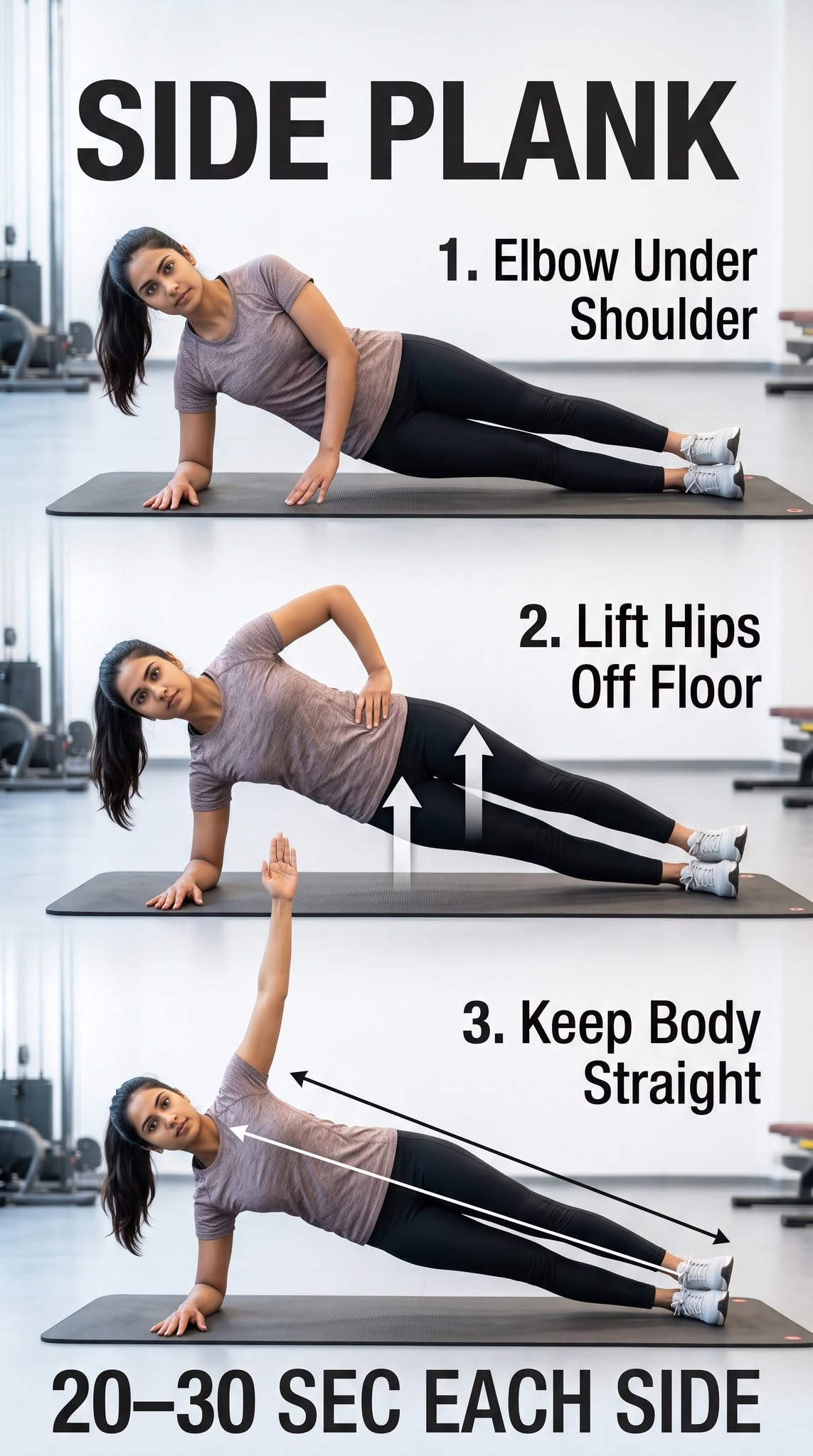
Building core strength goes far beyond basic crunch variations. The side plank is an essential isometric bodyweight exercise designed to target lateral core stability, strengthen the oblique muscles, and reinforce spinal alignment without putting excessive stress on the lower back.
In the graphic above, three fundamental steps outline the perfect form for the Side Plank: 1. Elbow Under Shoulder, 2. Lift Hips Off Floor, and 3. Keep Body Straight, targeting a hold of 20–30 Sec Each Side. In this comprehensive guide, we break down proper execution, muscle engagement, and tips to maximize your routine.
Step-by-Step Form Breakdown
+--------------------------------------------------------+
|                Side Plank Execution Map                |
+---------------------------+----------------------------+
                            |
                            v
+--------------------------------------------------------+
|  Foundation Setup         |  Dynamic Elevation         |
|  - Elbow Under Shoulder   |  - Lift Hips Off Floor     |
|    (Stack joint safely)   |    (Engage obliques)       |
+---------------------------+----------------------------+
|  Full Alignment           |                            |
|  - Keep Body Straight     |                            |
|    (Head to heels line)   |                            |
+--------------------------------------------------------+
1. Elbow Under Shoulder
-
Form Focus: Position your supporting forearm flat on the mat with your elbow placed directly beneath your shoulder joint.
-
Key Benefit: Stacking the joint creates a stable anatomical foundation, protecting your shoulder capsule from unnecessary strain and shear forces.
2. Lift Hips Off Floor
-
Form Focus: Engage your obliques, glutes, and core to press through the supporting forearm, driving your hips upward off the floor.
-
Key Benefit: Activates the internal and external obliques, transverse abdominis, and quadratus lumborum to stabilize the torso.
3. Keep Body Straight
-
Form Focus: Extend your top arm upward or rest it along your side while maintaining a rigid, straight line from head to ankles.
-
Key Benefit: Ensures full-body tension, prevents hip sagging, and promotes optimal spinal alignment during the 20–30 Sec Each Side hold.
Exercise Summary & Target Muscle Table
| Step | Technique Instruction | Primary Muscles Targeted | Key Objective |
| Step 1 | Position elbow directly under shoulder | Deltoids, Rotator Cuff, Upper Back | Joint stability & base foundation |
| Step 2 | Drive hips upward off the mat | Obliques, Gluteus Medius, Core | Lateral trunk contraction & lift |
| Step 3 | Maintain a straight line head-to-heels | Transverse Abdominis, Glutes, Spine | Isometric endurance & alignment |
Core Fitness, Personal Wellness, and Daily Life
Developing functional lateral strength directly enhances mobility, posture, and athletic longevity.
Prioritizing foundational core exercises supports long-term physical health and injury prevention. The continuous growth of home fitness and personal training drives expanding opportunities across the wellness business sector, helping individuals manage health routines and personal finance effectively well into retirement.
Essential Tips for Perfect Form
-
Avoid Hip Sagging: Constantly drive the bottom hip upward to keep the lateral core engaged throughout the entire duration.
-
Breathe Rhythmically: Avoid holding your breath; maintain steady, deep nasal breathing to maintain core intra-abdominal pressure.
-
Modify as Needed: If holding the full plank is too challenging, drop your bottom knee to the mat while keeping a straight line from head to knees.
Conclusion
Mastering side plank form ensures maximum core activation while protecting your joints. Adding holds of 20–30 seconds on each side into your daily workout routine builds functional stability, better posture, and a stronger core.
How long can you hold a solid side plank? Share your personal workout records in the comments below!
FAQ Section
How long should beginners hold a side plank?
Beginners should aim for 20 to 30 seconds per side. Focus on strict form rather than duration; set quality always trumps overall hold time.
Why do my shoulders hurt during a side plank?
Shoulder pain often occurs when the elbow is placed too far forward or away from the body. Ensure your elbow is stacked directly beneath your shoulder joint to distribute weight evenly.
Can side planks help reduce back pain?
Yes. Side planks strengthen the quadratus lumborum and deep core muscles without flexing the lumbar spine, which helps stabilize the lower back and reduce strain.
