
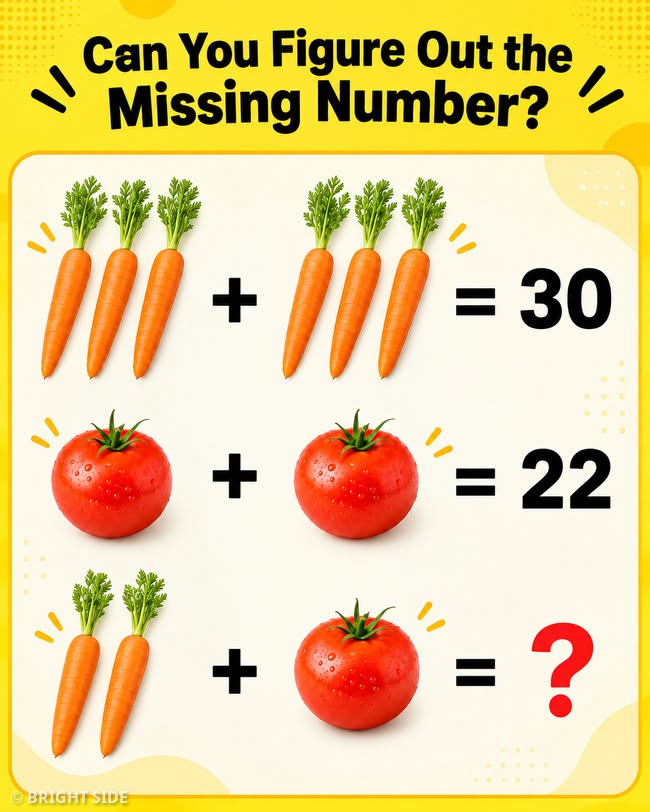
Picture-based math equations are a popular way to test logic, attention to detail, and basic algebra skills. These puzzles often include subtle visual details—such as varying quantities of items in a group—that test how carefully you observe the image.
In the math brain teaser graphic above, three equations are presented using carrots and tomatoes:
Header: “Can You Figure Out the Missing Number?”
Visual Equations:
Equation 1: 3 Carrots + 3 Carrots = 30
Equation 2: 1 Tomato + 1 Tomato = 22
Equation 3: 2 Carrots + 1 Tomato = ?
In this guide, we break down the math step by step to reveal the final answer.
Strategy Overview
+--------------------------------------------------------+
|               Algebraic Value Breakdown                |
+---------------------------+----------------------------+
                            |
                            v
+--------------------------------------------------------+
|  Item Values              |  Final Equation            |
|  - 3 Carrots = 15         |  - 2 Carrots = 10          |
|  - 1 Carrot = 5           |  - 1 Tomato = 11           |
|  - 1 Tomato = 11          |                            |
+---------------------------+----------------------------+
                            |
                            v
+--------------------------------------------------------+
|  Final Calculation                                     |
|  - 10 + 11 = 21                                        |
+--------------------------------------------------------+
Step-by-Step Mathematical Solution
-
Equation 1: 3 Carrots + 3 Carrots = 30
-
This equals 6 total carrots = 30.
-
Dividing 30 by 6 gives 1 Carrot = 5.
-
Therefore, a bundle of 3 carrots = $3 \times 5 = 15$.
-
-
Equation 2: 1 Tomato + 1 Tomato = 22
-
2 Tomatoes = 22.
-
Dividing 22 by 2 gives 1 Tomato = 11.
-
-
Equation 3 (Final Calculation): 2 Carrots + 1 Tomato = ?
-
2 Carrots = $2 \times 5 = 10$.
-
1 Tomato = 11.
-
Calculation: $10 + 11 = \mathbf{21}$.
-
Picture Equation Breakdown Table
| Line Item | Visual Image Description | Mathematical Value |
| Single Carrot | 1 individual carrot | 5 |
| Bundle of 3 Carrots | 3 carrots ($3 \times 5$) | 15 |
| Bundle of 2 Carrots | 2 carrots ($2 \times 5$) | 10 |
| Single Tomato | 1 red tomato | 11 |
| Final Equation | 2 Carrots (10) + 1 Tomato (11) | 21 |
Mental Agility, Brain Health, and Problem Solving
Solving daily logic puzzles and visual arithmetic exercises keeps working memory active and enhances visual observation skills.
Exercising numerical reasoning directly supports overall brain health and cognitive function. Developing strong attention to detail benefits professionals across technical and business environments, helping individuals manage personal finance calculations accurately, analyze data sets efficiently, and maintain cognitive sharpness through retirement.
Tips for Solving Picture Math Puzzles
-
Count Individual Items: Always look closely at grouped items (like carrots or fruits) to see if the quantity changes between lines.
-
Assign Single-Unit Values: Determine the value of one single item first before computing larger groups.
-
Check the Final Operators: Ensure you note whether the final line uses addition, subtraction, or multiplication.
Conclusion
By calculating individual item values, 1 carrot equals 5 and 1 tomato equals 11. Therefore, 2 carrots (10) + 1 tomato (11) = 21.
Did you notice the bundle change from 3 carrots to 2 carrots on the last line? Share your result in the comments below!
FAQ Section
What is the trick in this carrot and tomato math puzzle?
The key detail is noticing that the first line shows bundles of 3 carrots (value 15 each), while the final line shows a bundle of only 2 carrots (value 10).
What is the correct final answer?
The correct final answer is 21.
