
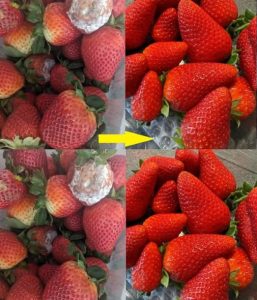
Fresh strawberries are a favorite seasonal fruit, but their delicate skin and high moisture content make them highly perishable. Social media visual guides often show stark before-and-after contrasts—depicting fuzzy, moldy berries next to bright, pristine ones—to highlight how proper washing and storage techniques can extend produce shelf life.
Understanding why strawberries spoil quickly and applying evidence-based food safety practices helps prevent food waste, saves money, and keeps your berries fresh for days longer.
Why Strawberries Mold So Quickly
Strawberries are soft-fleshed fruits that absorb moisture easily. Mold spores, particularly Botrytis cinerea (gray mold), naturally exist on fruit surfaces in the environment.
1. Excess Moisture Trapped in Containers
When strawberries are stored in closed plastic clamshells without proper airflow, condensation builds up. Moisture creates the ideal breeding ground for mold spores to germinate and spread rapidly throughout the container.
2. Cross-Contamination
If a single berry develops mold, invisible fungal hyphae and spores spread quickly to neighboring fruits through direct contact, spoiling the entire container in a short time.
Evaluating Storage Hacks vs. Food Safety Realities
It is crucial to distinguish between safe preservation methods and risky food consumption habits:
| Common Storage Claim / Practice | Food Safety Reality | Recommended Best Practice |
| Washing Berries Before Storing |
Moisture left on stored berries accelerates mold growth |
Wash berries under cold water only right before eating |
| Dilute Vinegar Bath Rinse | Vinegar solution kills surface mold spores and bacteria without affecting flavor | Submerge berries in 3:1 water-to-vinegar solution, dry thoroughly, then store |
| Cutting Off Moldy Parts |
Soft fruits allow microscopic mold toxins to penetrate deep inside |
Discard moldy berries immediately to protect surrounding fresh fruit |
| Airtight Glass Container Storage | Lining glass containers with paper towels absorbs excess moisture | Store unwashed, dry berries in a breathable or paper-lined container |
Practical Tips to Extend Strawberry Freshness
Keep your berries fresh and vibrant with these kitchen practices:
-
Sort Immediately After Purchasing: Remove and discard any bruised, soft, or visibly moldy strawberries as soon as you bring them home to prevent spores from spreading.
-
Use a Vinegar Wash Method: Soak fresh berries in a bowl containing three parts water and one part white vinegar for 5 minutes. Rinse thoroughly with cold water to remove vinegar taste.
-
Dry Completely Before Refrigeration: Spread berries flat on paper towels or clean cloth towels until completely dry before transferring them to storage.
-
Line Containers with Paper Towels: Place paper towels at the bottom of a container to catch ambient moisture and condensation inside the refrigerator.
-
Keep Stems Intact Until Eating: Leave the green caps (calyx) on berries until you are ready to serve them, as removing stems opens the fruit to bacterial entry.
Fascinating Facts About Strawberries
-
Not True Berries: Botanically, strawberries are not true berries; they are aggregate accessory fruits whose red fleshy tissue stems from the plant’s receptacle.
-
Seeds on the Outside: The tiny yellow specks on the strawberry’s surface are actually individual fruits called achenes, each containing a single seed inside.
-
Vitamin C Powerhouse: Gram for gram, fresh strawberries contain more vitamin C than oranges!
Food Safety, Grocery Savings, and Financial Planning
Preventing food waste directly benefits your household budget. Throwing away spoiled produce regularly adds up to hundreds of dollars in wasted grocery spending each year.
Integrating practical food preservation habits with smart meal planning, household budgeting, and emergency savings ensures that your home budget remains optimized while reducing daily waste.
Conclusion
Strawberries may be delicate, but using proper handling, vinegar washes, and moisture control allows you to double their shelf life and enjoy fresh berries longer. By prioritizing food safety and discarding spoiled fruit, you keep your kitchen safe, sustainable, and cost-effective.
Frequently Asked Questions (FAQ)
Can I eat a strawberry if I cut off the moldy part?
No. Because strawberries are soft and porous, mold mycelium and unseen mycotoxins can penetrate far beyond the visible fuzzy surface.
How long do fresh strawberries last in the fridge?
Unwashed strawberries stored properly in a breathable, paper-lined container typically last 5 to 7 days in the refrigerator.
Does a vinegar wash make strawberries taste like vinegar?
Not at all! As long as you rinse the berries thoroughly with cold water after their brief soak, no vinegar taste remains.
