
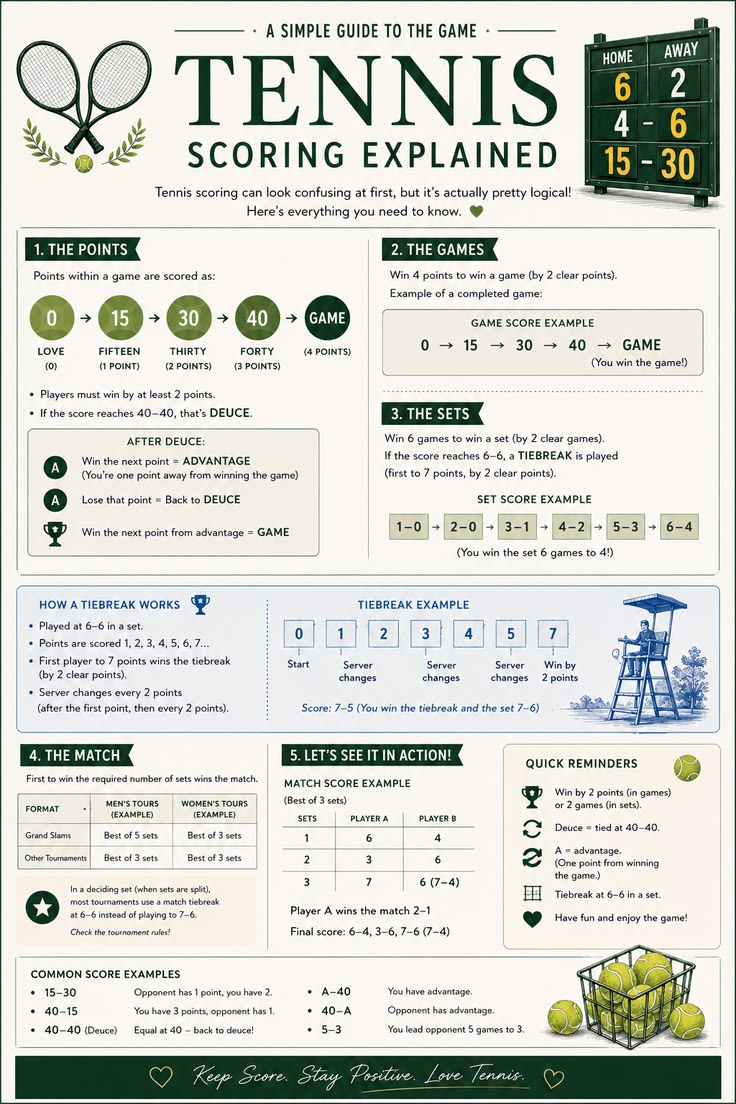
Tennis scoring can look confusing at first, but it is actually pretty logical! Whether you are watching a Grand Slam tournament or learning to play, understanding points, games, sets, and matches makes following the sport effortless.
The infographic above breaks down everything you need to know about keeping score. Below is a clear guide to help you master tennis scoring rules.
1. The Points
Points within a individual game are scored in a traditional sequence:
+--------------+-------------------+-----------------+
| Score Term   | Numeric Value     | Meaning         |
+--------------+-------------------+-----------------+
| Love         | 0                 | Zero points     |
| 15           | 1 Point           | First point     |
| 30           | 2 Points          | Second point    |
| 40           | 3 Points          | Third point     |
| Game         | 4 Points          | Wins the game   |
+--------------+-------------------+-----------------+
(Note: Players must win by at least 2 clear points.)
What Happens at Deuce?
-
Deuce (40–40): Occurs when both players reach 40.
-
Advantage (A): The player who wins the next point after deuce gains the Advantage (one point away from winning the game).
-
Back to Deuce: If the player without Advantage wins the point, the score returns to Deuce.
-
Game Win: Winning a point from Advantage wins the game.
2. Games, Sets, and Tiebreaks
Winning a Game
To win a game, a player needs 4 points with a 2-point lead (e.g., Love $\rightarrow$ 15 $\rightarrow$ 30 $\rightarrow$ 40 $\rightarrow$ Game).
Winning a Set
-
Win 6 games to win a set (must lead by 2 clear games, like 6–4).
-
If the set score reaches 6–6, a Tiebreak is played.
How a Tiebreak Works
-
Points are counted standardly: 1, 2, 3, 4, 5, 6, 7…
-
The first player to 7 points (by 2 clear points) wins the tiebreak and the set (7–6).
-
The server changes after the first point, and then every 2 points thereafter.
3. Match Formats
The first player to win the required number of sets wins the match.
+--------------------+---------------------+---------------------+
| Tournament Level   | Men's Tours         | Women's Tours       |
+--------------------+---------------------+---------------------+
| Grand Slams        | Best of 5 sets      | Best of 3 sets      |
| Other Tournaments  | Best of 3 sets      | Best of 3 sets      |
+--------------------+---------------------+---------------------+
Quick Reminders & Score Examples
-
15–30: Opponent has 1 point, you have 2.
-
40–15: You have 3 points, opponent has 1.
-
A–40: You have advantage.
-
40–A: Opponent has advantage.
-
5–3: You lead your opponent 5 games to 3 in the set.
Frequently Asked Questions (FAQ)
What does “Love” mean in tennis scoring?
“Love” represents a score of zero. It is believed to originate from the French word l’œuf (egg), representing the shape of a zero.
What is a set tiebreak score?
When a set reaches 6–6, a tiebreak is played to 7 points (winning by 2). The set ends with a score of 7–6.
How long does a standard tennis match last?
Best-of-3 set matches typically take between 1.5 to 2.5 hours, while best-of-5 set Grand Slam matches can last 3 to 5 hours.
