
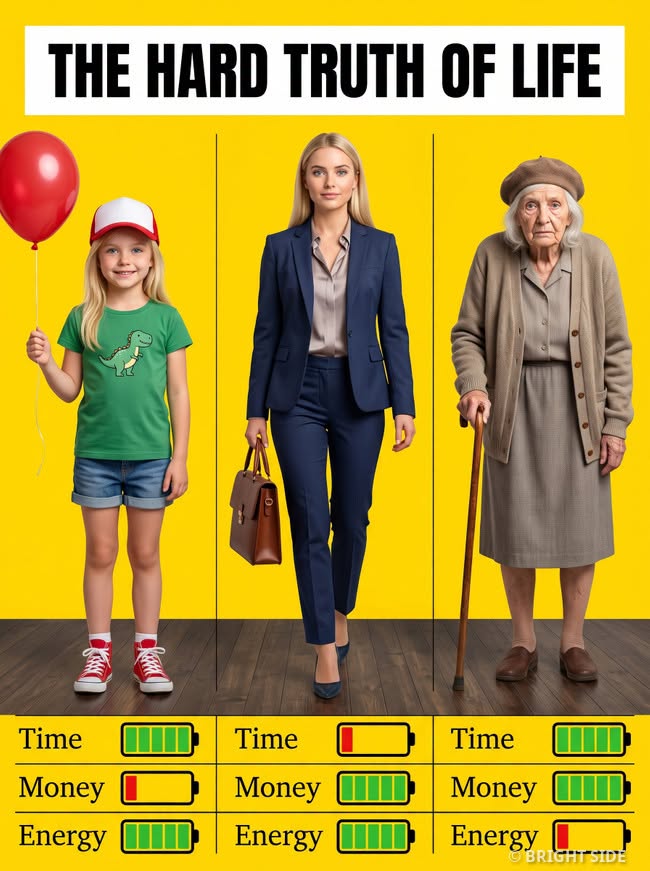
Throughout different stages of life, human experience is often shaped by the interplay of three vital resources: Time, Money, and Energy. The famous “Life Paradox” illustrates how rarely all three resources align simultaneously, creating distinct challenges and opportunities at each phase of life.
In the viral infographic above, three distinct life stages are depicted alongside resource battery meters:
Header: “THE HARD TRUTH OF LIFE”
Visual Breakdown:
Youth (Young Girl): High Time (Full Green Battery), Low Money (Empty Red Battery), High Energy (Full Green Battery).
Adulthood (Working Woman): Low Time (Empty Red Battery), High Money (Full Green Battery), High Energy (Full Green Battery).
Senior Years (Older Woman): High Time (Full Green Battery), High Money (Full Green Battery), Low Energy (Empty Red Battery).
In this guide, we analyze the dynamic between these three resources and explore strategies to create balance across every decade.
Strategy Overview
+--------------------------------------------------------+
|                Life Resource Dynamic                   |
+---------------------------+----------------------------+
                            |
                            v
+--------------------------------------------------------+
|  Resource Trade-Offs      |  Key Life Focus            |
|  - Youth: Time + Energy   |  - Growth & Education      |
|  - Adult: Money + Energy  |  - Career & Building       |
|  - Senior: Time + Money   |  - Leisure & Legacy        |
+---------------------------+----------------------------+
                            |
                            v
+--------------------------------------------------------+
|  Core Objective                                        |
|  - Optimize health, time management, and financial     |
|    planning to bridge the gaps in every life stage.    |
+--------------------------------------------------------+
Breakdown of the Three Life Stages
-
Youth (High Time, Low Money, High Energy): Children and young adults enjoy abundance in time and physical vitality, but generally lack financial independence or accumulated resources.
-
Adulthood (Low Time, High Money, High Energy): Working professionals generate income and possess high physical energy, but frequently sacrifice free time due to career, family, and daily obligations.
-
Senior Years (High Time, High Money, Low Energy): Retirees often enjoy free time and accumulated savings, yet face declining physical energy and health limitations.
Life Stage Resource Comparison Table
| Life Stage | Time Available | Financial Resources | Energy & Vitality | Main Life Focus |
| Youth | High (Full Battery) | Low (Empty Battery) | High (Full Battery) | Learning, play, growth |
| Adulthood | Low (Empty Battery) | High (Full Battery) | High (Full Battery) | Career, family, building wealth |
| Senior Years | High (Full Battery) | High (Full Battery) | Low (Empty Battery) | Leisure, reflection, legacy |
Life Balance, Personal Health, and Long-Term Well-Being
Recognizing the trade-offs between time, financial stability, and vitality allows individuals to make conscious, balanced lifestyle choices.
Prioritizing active living and stress management directly supports lifelong bodily health and vitality. Striking a healthy work-life balance serves individuals in corporate and business endeavors, helping people organize personal finance strategies effectively, safeguard free time, and ensure a vibrant, meaningful retirement.
How to Balance Time, Money, and Energy Today
-
Protect Your Health Early: Invest in physical fitness and nutrition during adulthood to preserve energy into your senior years.
-
Value Your Free Time: Set boundaries at work to enjoy personal moments while you still have the energy to experience them fully.
-
Plan Financially: Build sustainable savings and investment habits early to ensure financial comfort later in life.
Conclusion
While no single phase of life effortlessly provides maximum time, money, and energy at once, intentional living helps you make the absolute most of what you have right now.
Which resource do you feel you need more of in your current stage of life? Share your thoughts in the comments below!
FAQ Section
What is the “Time, Money, Energy” paradox?
It is a sociological concept pointing out that young people have time and energy but no money; adults have money and energy but no time; and seniors have time and money but declining energy.
How can working adults regain more time?
Working adults can regain time by setting professional boundaries, delegating tasks, practicing effective time management, and prioritizing work-life balance.
