
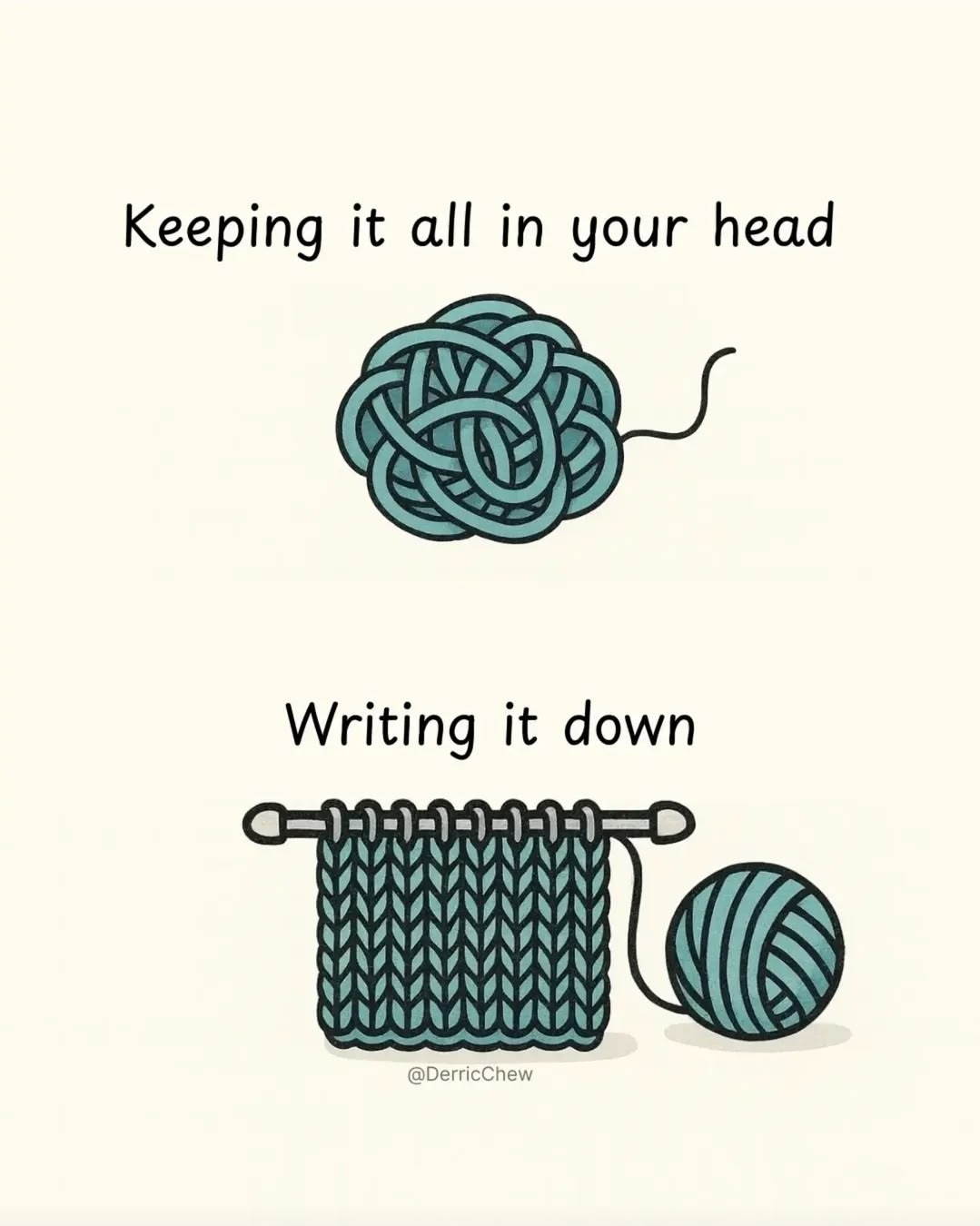
In our fast-paced daily lives, attempting to store every thought, task, and creative idea in memory often leads to mental fatigue and stress. Externalizing thoughts onto paper is one of the most effective ways to organize ideas and clear cognitive bandwidth.
In the conceptual illustration above, a simple yarn analogy contrasts two mental states: “Keeping it all in your head” (a tangled, messy ball of yarn) versus “Writing it down” (neatly knitted rows attached to a tidy yarn ball). In this guide, we explore why externalizing your thoughts enhances focus and mental clarity.
Mindset & Journaling Overview
+--------------------------------------------------------+
|                Cognitive Offloading Process            |
+---------------------------+----------------------------+
                            |
                            v
+--------------------------------------------------------+
|  Internal Mental Load     |  External Writing Process  |
|  - Tangled thoughts       |  - Categorized tasks       |
|  - High cognitive stress  |  - Clear visual structure  |
+---------------------------+----------------------------+
                            |
                            v
+--------------------------------------------------------+
|  Key Psychological Benefit                             |
|  - Reduced anxiety & improved focus                    |
+--------------------------------------------------------+
1. Internal Mental Load (“Keeping It All in Your Head”)
-
Cognitive Overload: Trying to store tasks, reminders, and worries internally creates a tangled mass of competing priorities.
-
Increased Anxiety: Unwritten thoughts continuously loop in short-term memory, leading to unnecessary mental exhaustion.
2. External Writing Process (“Writing It Down”)
-
Structured Thinking: Transferring thoughts onto paper turns scattered ideas into ordered, structured rows of actionable information.
-
Mental Space: Writing offloads working memory, giving your brain room to concentrate deeply on execution rather than recall.
Mental Clarity Comparison Table
| Mental Strategy | Visual Analogy | Impact on Memory | Psychological Outcome |
| Keeping in Head | Tangled ball of yarn | Overloads short-term memory | Stress, confusion, and distraction |
| Writing it Down | Neat, knitted structure | Externalizes memory load | Calm, clarity, and organized focus |
Mental Well-Being, Productivity, and Lifestyle
Adopting systematic journaling and note-taking techniques supports consistent personal growth and cognitive efficiency.
Organizing your daily thoughts actively improves mental health and emotional equilibrium. Structured planning drives efficiency across professional business environments, enabling individuals to manage project goals and personal finance with clarity leading smoothly into retirement.
Simple Daily Writing Habits to Get Started
-
Brain Dump Daily: Spend 5 minutes every morning writing down everything on your mind without overthinking the structure.
-
Keep a Pocket Notebook: Carry a small pad or phone app to capture spontaneous ideas before they tangle up your thoughts.
-
End-of-Day Review: Outline tomorrow’s top 3 priorities before going to bed to ensure a restful night’s sleep.
Conclusion
Just like turning a tangled ball of yarn into a neatly knitted scarf, writing your thoughts down transforms mental chaos into order and actionable clarity.
Do you prefer writing on paper or using digital notes app? Share your thoughts in the comments below!
FAQ Section
What is cognitive offloading?
Cognitive offloading is the practice of using physical tools (like notebooks or apps) to store information outside your brain, reducing mental fatigue.
How does journaling reduce stress?
Journaling helps externalize worries, helping you organize scattered emotions and view problems with greater clarity and perspective.
