
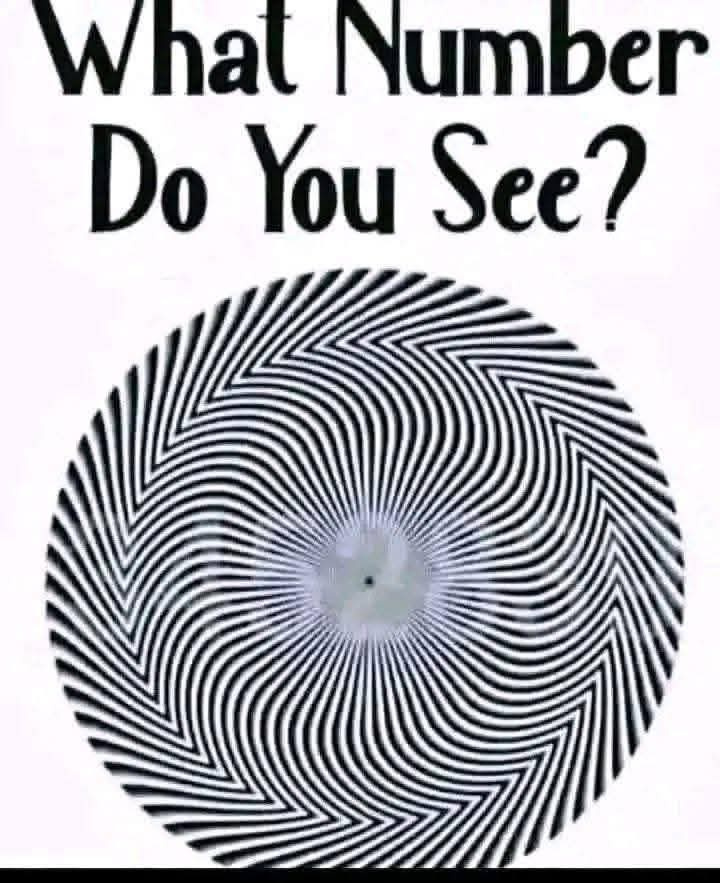
In a world saturated with digital input, our eyes and brains are constant collaborators, interpreting a storm of light and pattern into meaningful information. Occasionally, this collaboration breaks down, creating a phenomenon that has fascinated humans for centuries: the optical illusion.
A specific type of illusion, often called a “hidden number” or “hidden digit” trick, has recently captivated social media users, generating millions of comments and debates. These images, which often feature a circular pattern of swirling or jagged lines, demand a second, deeper look to reveal a embedded message.
Understanding why these images work—and why different people see different numbers—offers a fascinating window into our own cognition. Let’s dive deep into the fascinating world of visual perception, color vision, and how our brains can be tricked by clever design.
1. What Are Optical Illusions and Why Do They Exist?
At its core, an optical illusion (or visual illusion) occurs when the brain’s interpretation of visual information contradicts the physical reality. Our visual system is not a camera; it is a complex processing engine that relies on prior knowledge, context, and assumptions to build a stable view of the world.
The Brain’s Shortcuts
The brain processes an enormous amount of information, and to do so efficiently, it uses cognitive shortcuts. Illusions exploit these shortcuts by presenting patterns, colors, or arrangements that the brain’s default algorithms interpret incorrectly. The swirling lines in the viral hidden-number image are designed precisely to confuse your visual cortex.
2. The Science of Visual Perception and “Hidden Figures”
Why is the number in this image so hard to see for some, but instantaneous for others? The answer lies in how our visual processing system prioritizes different elements of a scene.
Spatial Frequency and Contrast
The illusion works on the principle of spatial frequency and contrast reduction. The dense, high-contrast, black-and-white lines in the circle dominate your immediate vision. The hidden digits are embedded with a much subtler contrast variation (or perhaps a slight color shifts, if it’s a chromatic illusion). Your brain must work to filter out the high-frequency “noise” of the swirly lines to reveal the low-contrast “signal” of the digits.
Perceptual Grouping (Gestalt Principles)
Psychologists use Gestalt principles to describe how the brain organizes visual elements into whole figures. The swirling lines create strong “good continuation,” making the brain want to see one large, continuous vortex rather than segmented digits. To see the number, your brain must de-group the main pattern and re-group the subtle variations.
3. The Specifics of Hidden-Digit Tests
These specific tests often vary slightly in how they embed the numbers, making different versions more difficult or easier depending on your specific vision strengths.
Chromatic (Color-Based) Illusions
Some of these images, known as color blind tests (like the Ishihara test developed by the medical industry), use a matrix of colored dots. The digits are in one color pattern, and the background is in another. People with red-green color deficiency cannot distinguish the contrast and fail to see the number. This is a common health screening.
Luminance and Spatial Illusions
The swirling black-and-white version is purely based on luminance (brightness contrast) and spatial frequency. It is less about color vision and more about processing subtle brightness differences and pattern segregation. This is where your spatial reasoning and visual cortex processing education really shows.
4. Why Do Different People See Different Numbers?
This is where the viral debate heats up. One person sees “1520,” another sees “452,” and some see nothing at all. This difference can be caused by several factors:
Vision Variations
Individual vision quality, including visual acuity and contrast sensitivity, plays a large role. If you need corrective lenses (for which you might need special insurance and attorney consulting for a prescription error), your eyes might struggle to filter out the high-frequency pattern. Subtle, undiagnosed medical conditions affecting contrast perception can also be a factor.
Screen Quality and Settings
The screen you use to view the illusion changes everything. High-resolution screens (like the latest technology displays), monitor brightness, and the viewing angle can either accentuate or diminish the subtle contrast difference of the hidden number. Looking at it on a small phone vs. a large monitor matters.
Cognitive Interpretation
Our brains are predictive engines. If we expect to see a certain number based on context or prior suggestions, our brain might bias itself toward finding that pattern, even if the visual signal is weak.
5. Practical Visual “Hacks” to See the Number
If you’re struggling to crack the code, try these user-verified tricks that exploit how your eyes and brain interact with the illusion:
Step 1: Alter Your Distance
Stand up and back away from your screen. By making the entire image smaller on your retina, you reduce the brain’s focus on the fine, distracting details of the swirling lines, allowing the larger, subtle pattern of the digits to become more apparent.
Step 2: The Squint Technique
When you squint, you slightly defocus your vision, which naturally filters out high-spatial frequency details (the lines) and lets the lower-spatial frequency structure (the number) emerge.
Step 3: View an Angel
Try tilting your device or moving your head up and down while looking at the image. The hidden contrast might be more visible at a non-head-on angle due to how light is emitted from certain screens.
Step 4: The Scroll Trick (If on a Phone)
Gently scroll the image up and down slightly. The human brain is excellent at detecting changes in motion; by introducing consistent movement, you can sometimes make the subtle hidden object “pop” out from the stable pattern.
6. How Visual Tricks and Digital Scams Are Connected
Viral visual tricks are often harmless, but the same concepts are used by sophisticated scammers online. Understanding the psychology of being tricked by visual information is a valuable skill in the finance and investment world.
The Psychology of Misdirection
The swirling pattern misdirects your attention away from the subtle numbers. In financial scams, deceptive visual layouts, misleading advertisements, and complex fine print are used to loan money under false pretenses, leading unsuspecting victims into unnecessary mortgage debt. A scammer will intentionally make critical information (the signal) low-contrast or hidden among a sea of complicated details (the noise).
Identifying Deceptive Technology
As modern technology advances, scammers can create even more convincing deceptive interfaces. From visually altered bank statements to deepfake videos, the ability to trick the visual system is becoming more powerful. Training yourself to see past the initial “swirling lines” of a bad deal can save your retirement fund or prevent you from needing complex legal services.
7. The Evolutionary Advantage of Spotting Hidden Patterns
Why do some people naturally have better pattern-spotting abilities? This skill was an evolutionary advantage for our ancestors.
Hunter-Gatherer Vision
In nature, seeing the subtle color or brightness change of a predator hiding in tall, high-contrast grass could mean the difference between life and death. The ability to spot camouflage is essentially the biological version of solving the hidden number illusion.
Conclusion
Optical illusions like the swirling hidden-digit vortex are more than just social media fun; they are powerful, scalable demonstrations of how the human brain processes visual information. By understanding spatial frequency, contrast, and cognitive bias, we can appreciate why different people experience the same physical stimulus in different ways.
Remember this next time you are faced with a complex situation, whether it is a complicated visual trick or a confusing financial loan application: Step back, defocus, and look for the subtle signal that is trying to tell you the real story.
Frequently Asked Questions (FAQ)
What is the final answer to this visual number illusion?
The most common and definitive answer in this widely shared image is 45283. Different crops or variations may change the number slightly, but that is the consensus sequence.
Can optical illusions hurt my eyes?
No, staring at optical illusions is not dangerous. However, the extreme high-contrast and repetitive patterns can sometimes cause visual fatigue or a temporary afterimage effect.
Are these images valid tests for vision health?
No. These viral images are entertainment. For a real assessment of your color vision, contrast sensitivity, and general medical health of your eyes, you must see an eye health professional (optometrist or ophthalmologist).
Can squinting actually help me see better?
In a way, yes! Squinting defocuses your vision, filtering out the “visual noise” (the high-frequency line pattern) and letting the “visual signal” (the lower-frequency hidden shape) become more visible. It is not for general vision correction, but it works for certain pattern-recognition tasks.
