
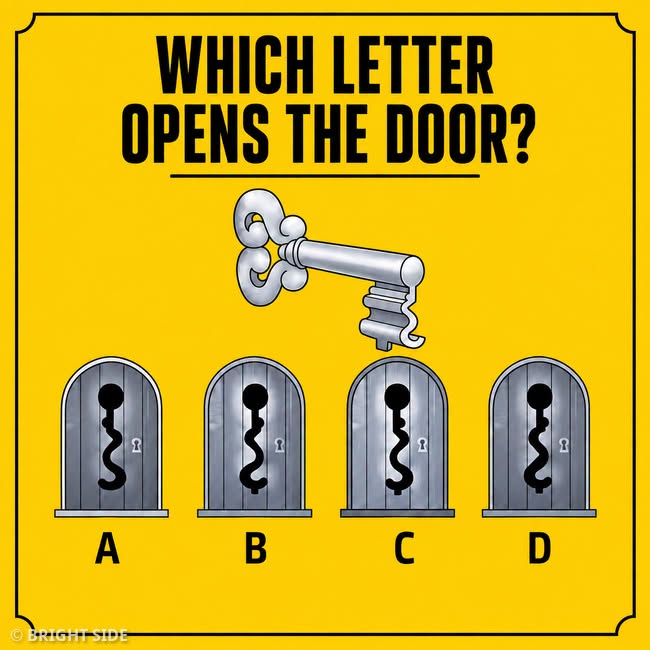
Keyhole riddles and visual matching games test spatial reasoning, attention to detail, and pattern recognition skills. At first glance, keyhole silhouettes can look remarkably similar, but analyzing the precise order of curves, notches, and ridges reveals the single correct match.
In the puzzle graphic above, a silver skeleton key is displayed above four arched doors labeled A, B, C, and D:
Header: “WHICH LETTER OPENS THE DOOR?”
Visual Features of the Key:
Key Blade Profile: Displays a distinctive wavy vertical cut with specific ridges and notches.
Top Cut: A smooth upper wave curve.
Middle Cut: A pronounced outward bump/ridge.
Bottom Cut: A squared bottom tooth at the tip.
In this guide, we break down each door options keyhole silhouette to identify the correct match.
Strategy Overview
+--------------------------------------------------------+
|                Visual Keyhole Analysis                 |
+---------------------------+----------------------------+
                            |
                            v
+--------------------------------------------------------+
|  Inspection Features      |  Key Comparison Traits     |
|  - Wavy blade outline     |  - Left/right wave direction|
|  - Notch placements       |  - Bottom tooth position   |
|  - Keyhole opening width  |  - Symmetry & alignment    |
+---------------------------+----------------------------+
                            |
                            v
+--------------------------------------------------------+
|  Core Objective                                        |
|  - Eliminate mismatched keyhole silhouettes to find    |
|    the exact cutout corresponding to the key blade.    |
+--------------------------------------------------------+
Step-by-Step Keyhole Breakdown
Comparing the silver key’s blade profile against each door keyhole:
-
Door A: The keyhole curve direction or notch depth does not align with the key’s wavy blade profile.
-
Door B: The lower notch and middle curve directions are inverted, preventing the key from fitting.
-
Door C: The Correct Match—Door C’s keyhole cutout precisely mirrors every wave, ridge, and bottom tooth on the key blade.
-
Door D: Features slight alterations in the middle ridge curvature and bottom tooth alignment.
Keyhole Comparison Table
| Door Letter | Upper Wave Match | Middle Ridge Match | Bottom Tooth Match | Status |
| Door A | Mismatch | Match | Mismatch | Incorrect |
| Door B | Mismatch | Mismatch | Match | Incorrect |
| Door C | Exact Match | Exact Match | Exact Match | CORRECT |
| Door D | Match | Mismatch | Mismatch | Incorrect |
Cognitive Sharpness, Visual Fitness, and Problem Solving
Engaging in regular visual puzzles and spatial alignment challenges enhances mental agility and observational accuracy.
Sharpening spatial reasoning skills directly supports cognitive health and mental flexibility. Strong attention to detail benefits professionals in technical and business environments, helping individuals manage personal finance documentation, review complex data, and preserve cognitive sharpness through retirement.
Tips for Solving Keyhole Visual Riddles Quickly
-
Follow the Contour from Top to Bottom: Trace the key blade profile sequentially from the shaft down to the tip.
-
Focus on Asymmetrical Features: Identify distinct notches or tooth directions that quickly rule out wrong options.
-
Verify Bottom Features: Check the final tooth or base shape to confirm the exact alignment before selecting your answer.
Conclusion
By carefully comparing the blade curves, ridges, and teeth, Door C is the exact matching keyhole that opens the door.
Did you spot the correct keyhole on your first look? Share your answer in the comments below!
FAQ Section
Which letter opens the door in this puzzle?
Door C is the correct answer, matching the key’s exact blade profile.
How do visual matching puzzles train the brain?
They challenge spatial visualization, short-term visual memory, and pattern discrimination.
