
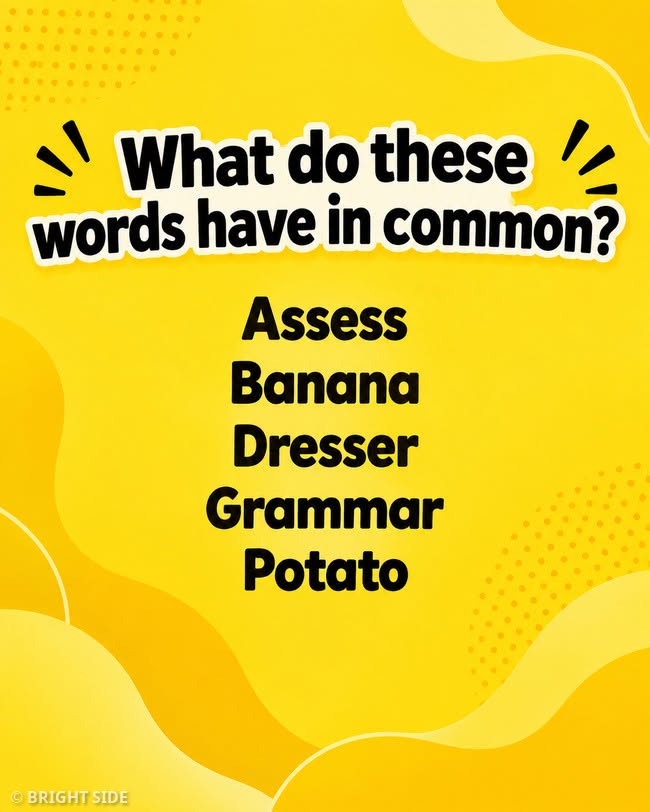
Word riddles and brain teasers are a fantastic way to challenge cognitive function, test pattern recognition, and engage in problem-solving. While the words “Assess,” “Banana,” “Dresser,” “Grammar,” and “Potato” seem entirely unrelated at first glance—spanning fruit, furniture, language, and vegetables—they share a unique linguistic trick.
In the puzzle image above, five words are listed on a yellow background under a brain-teaser prompt:
Header: “What do these words have in common?”
Listed Words:
Assess
Banana
Dresser
Grammar
Potato
In this guide, we reveal the hidden pattern that connects all five words and explain how the riddle works.
Strategy Overview
+--------------------------------------------------------+
|                  Word Riddle Solution                  |
+---------------------------+----------------------------+
                            |
                            v
+--------------------------------------------------------+
|  Step 1: Take First Letter|  Step 2: Move to End       |
|  - e.g., "Banana" -> B    |  - "anana" + B = "ananaB"  |
+---------------------------+----------------------------+
                            |
                            v
+--------------------------------------------------------+
|  Step 3: Read Backwards                                |
|  - "ananaB" reversed = "Banana" (Original Word!)       |
+--------------------------------------------------------+
The Hidden Rule Explained
If you take the first letter of each word and move it to the end, the remaining string of letters spelled backwards spells the exact original word!
-
Banana: Move ‘B’ to the end $\rightarrow$
ananaB. SpellananaBbackwards $\rightarrow$ Banana. -
Assess: Move ‘A’ to the end $\rightarrow$
ssessA. SpellssessAbackwards $\rightarrow$ Assess. -
Dresser: Move ‘D’ to the end $\rightarrow$
resserD. SpellresserDbackwards $\rightarrow$ Dresser. -
Grammar: Move ‘G’ to the end $\rightarrow$
rammarG. SpellrammarGbackwards $\rightarrow$ Grammar. -
Potato: Move ‘P’ to the end $\rightarrow$
otatoP. SpellotatoPbackwards $\rightarrow$ Potato.
Word Transformation Table
| Original Word | Move First Letter to End | Reversed Result (Backwards) | Pattern Confirmed? |
| Assess | ssessA | A – s – s – e – s – s $\rightarrow$ Assess | Yes |
| Banana | ananaB | B – a – n – a – n – a $\rightarrow$ Banana | Yes |
| Dresser | resserD | D – r – e – s – s – e – r $\rightarrow$ Dresser | Yes |
| Grammar | rammarG | G – r – a – m – m – a – r $\rightarrow$ Grammar | Yes |
| Potato | otatoP | P – o – t – a – t – o $\rightarrow$ Potato | Yes |
Brain Teasers, Cognitive Health, and Daily Focus
Engaging in regular word games and memory exercises keeps the mind sharp and improves analytical thinking skills.
Prioritizing mental exercise directly supports brain health and cognitive performance across all ages. Cultivating strong problem-solving skills benefits professionals in analytical roles and business environments, helping individuals manage personal finance decisions, make calculated career choices, and maintain mental sharpness straight into retirement.
Tips for Solving Pattern-Based Word Riddles
-
Check Letter Frequency: Notice repeating letter patterns (such as double ‘s’ or repeated ‘a-n’ combinations) that often signal symmetry or palindrome-like behaviors.
-
Test Structural Manipulation: Try reversing the word, dropping the first or last letter, or anagramming consonants to reveal hidden mechanisms.
-
Break Down Syllables: Look at how syllables mirror each other across the middle vowel sounds.
Conclusion
Solving brain teasers like this shows how creative wordplay can turn ordinary nouns and verbs into clever linguistic puzzles.
How long did it take you to figure out the hidden pattern? Share your answer time or favorite riddle in the comments below!
FAQ Section
What is the name for words with this specific property?
While they are closely related to palindromes, these are often referred to as “almost-palindromes” or “shift-reversed words” in recreational linguistics.
Are there other words that follow this rule?
Yes! Other examples include words like “Revive” and “Uneven.”
