
Algebraic riddles based on scale measurements are a popular way to test logical reasoning and simultaneous equations. By analyzing the pairwise combinations of the three animals, you can calculate both their combined total weight and their individual weights.
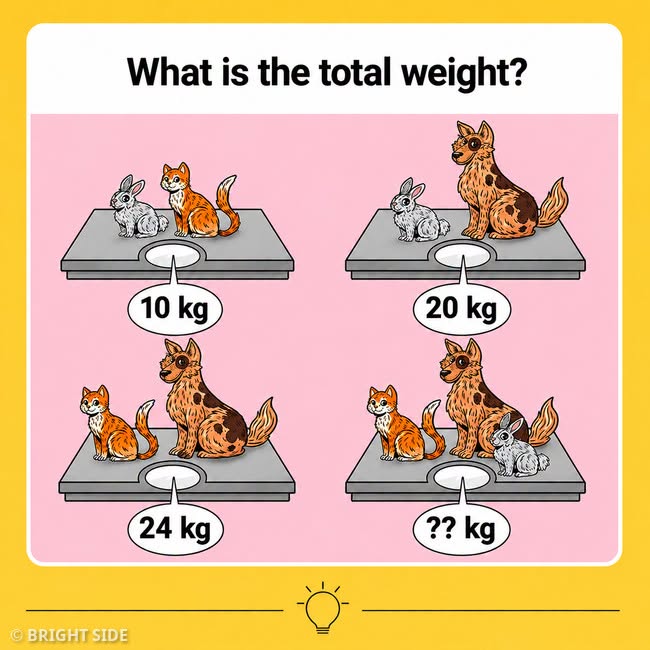
In the graphic featured above, three pets—a rabbit, a cat, and a dog—are weighed in different configurations:
Header: “What is the total weight?”
Visual Breakdown:
Top-Left Scale: Rabbit + Cat = 10 kg
Top-Right Scale: Rabbit + Dog = 20 kg
Bottom-Left Scale: Cat + Dog = 24 kg
Bottom-Right Scale: Cat + Dog + Rabbit = ?? kg
Visual Attribution:
Source: Courtesy of Bright Side.
In this guide, we break down the simultaneous equations step by step to find the total weight.
Strategy Overview
+--------------------------------------------------------+
|                 Algebraic Setup Dynamic                |
+---------------------------+----------------------------+
                            |
                            v
+--------------------------------------------------------+
|  Pairwise Equations       |  Combined Sum Calculation  |
|  - R + C = 10 kg          |  - Add all 3 equations     |
|  - R + D = 20 kg          |  - 2(R + C + D) = 54 kg    |
|  - C + D = 24 kg          |  - Divide total by 2       |
+---------------------------+----------------------------+
                            |
                            v
+--------------------------------------------------------+
|  Core Objective                                        |
|  - Determine the total weight of the rabbit, cat, and  |
|    dog standing together on the scale.                 |
+--------------------------------------------------------+
Step-by-Step Mathematical Solution
Let represent the weight of the rabbit, represent the weight of the cat, and represent the weight of the dog.
-
Set Up the Pairwise Equations:
-
Add All Three Equations Together:
-
Divide by 2 to Find Total Weight:
-
Calculate Individual Animal Weights (Optional Verification):
-
Dog ():
-
Cat ():
-
Rabbit ():
-
Checking the individual weights () confirms the result!
Weight Measurement Summary Table
Math Skills, Health, and Daily Problem Solving
Solving visual algebra puzzles keeps logical reasoning, pattern recognition, and working memory active.
Exercising numerical problem-solving skills directly supports brain health and mental agility. Building strong math confidence benefits professionals across administrative and business environments, helping individuals manage personal finance calculations, audit budget details, and stay mentally active through retirement.
