
Public transit etiquette often presents passengers with real-time ethical dilemmas: when a single seat opens up on a crowded bus or subway car, who has the most compelling need to sit down?
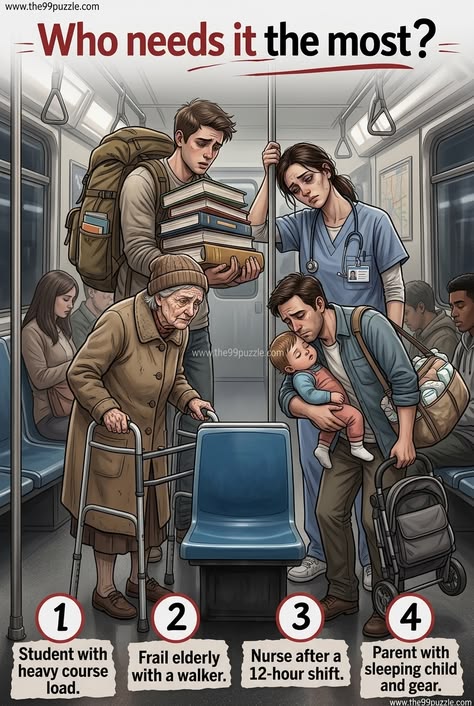
In the viral puzzle graphic above, four individuals are standing in a subway car near a single open seat under the question “Who needs it the most?”:
-
The Student: Carrying a heavy backpack and a tall stack of textbooks.
-
The Elderly Woman: Frail and relying on a walker for balance.
-
The Healthcare Worker: Exhausted after a demanding 12-hour shift.
-
The Parent: Carrying a sleeping toddler alongside a stroller and diaper bag.
In this article, we break down the ethical arguments, public transit rules, and physical safety considerations for each choice.
Breakdown of the Candidates
+--------------------------------------------------------+
|              Public Transit Priority Hierarchy          |
+---------------------------+----------------------------+
                            |
                            v
+--------------------------------------------------------+
|  Primary Need (Safety)    |  Secondary Need (Fatigue)  |
|  - Frail Elderly Person   |  - Parent with Baby        |
|  - High fall risk         |  - Healthcare Worker       |
|                           |  - Student with Books      |
+--------------------------------------------------------+
1. The Frail Elderly Woman with a Walker (#2)
-
Safety & Stability Risk: Standing on a moving vehicle is hazardous for anyone with mobility challenges. Sudden stops or lurches pose a high risk of falls, bone fractures, or serious injury.
-
Transit Guidelines: Nearly all public transportation authorities globally designate front seating specifically for senior citizens and individuals with physical disabilities as a matter of safety policy.
2. The Parent Carrying a Sleeping Child (#4)
-
Physical Burden: Holding a sleeping toddler while managing a stroller and heavy gear requires balance, especially on a moving train.
-
Safety Factor: If the train lurches, protecting both the child and oneself while standing without holding a handrail is difficult.
3. The Exhausted Nurse (#3)
-
Physical Fatigue: Working a 12-hour shift on one’s feet causes extreme physical exhaustion.
-
Social Empathy: Healthcare workers perform essential, physically taxing labor, making them a popular choice among commentators.
4. The Student with Books (#1)
-
Physical Strain: Carrying a heavy backpack and a large stack of books exerts significant back strain.
-
Comparison: While burdened, the student is young and capable of setting books down on the floor or holding handrails for stability.
Priority Analysis Table
| Candidate | Primary Challenge | Safety / Injury Risk | Standard Transit Policy |
| 1. Student | Heavy book load | Low | Standard Passenger |
| 2. Elderly Person | Frailty, walker usage, balance issues | Critical (High Fall Risk) | Designated Priority Seating |
| 3. Healthcare Worker | Extreme physical fatigue | Low to Moderate | Standard Passenger |
| 4. Parent with Baby | Holding child, gear, balance strain | Moderate to High | Courtesy Seating Consideration |
Public Transit Etiquette, Health, and Community Life
Understanding priority seating etiquette ensures safer, more accessible public transportation for everyone.
Prioritizing vulnerable commuters protects public safety and physical health. Respectful community spaces foster strong social foundations and support transit business operations, while helping individuals manage daily urban commutes and personal finance comfortably throughout every phase of life into retirement.
The Verdict: What Does Official Etiquette Say?
From both an official policy standpoint and a physical safety perspective, Option 2 (The Frail Elderly Woman with a Walker) needs the seat the most.
While the nurse, parent, and student are all experiencing fatigue or discomfort, a moving train poses a severe safety hazard to someone who cannot easily balance or hold onto overhead straps without assistance.
Conclusion
While every person in the image represents a valid struggle, priority seating rules across public transit systems exist primarily to prevent injury to those most physically vulnerable to falls.
Who would you give the seat to in real life? Share your thoughts and reasons in the comments below!
FAQ Section
What is priority seating on public transportation?
Priority seating refers to designated seats near transit doors reserved for elderly passengers, pregnant women, passengers with disabilities, or individuals carrying small infants.
What should you do if multiple people need a seat?
If more than one passenger requires assistance, other able-bodied passengers nearby are encouraged to offer up their seats so everyone who needs support can sit safely.
